

Every saleable return becomes an operational bottleneck when serialized product verification routes are unclear. Buyers need a workflow that handles exceptions without adding another disconnected compliance system.
Schedule a demo with RxERP to see how VRS DSCSA workflows connect verification, serialized inventory, and return disposition inside one pharma-native ERP..
VRS DSCSA workflows use a Verification Router Service to route serialized product verification requests and return responses for saleable returns. They help wholesalers confirm returned product identifiers against manufacturer data before products move back into saleable inventory. The value is not the router alone. It is the way the response connects to inventory, exception review, and audit-ready records.
The practical question is not whether VRS belongs in the DSCSA conversation. It is how your team can evaluate a connected verification workflow without confusing routing, serialization, and the return decision itself. This guide explains the roles, risks, and buying questions pharma supply chain teams should bring into a VRS review.
VRS DSCSA basics for saleable returns.
VRS stands for Verification Router Service. In a VRS DSCSA workflow, the service routes a serialized product verification request to the right source and returns a response. For saleable returns, that answer helps the receiving team decide whether the product can continue through the return process or must move into exception review.
What VRS does.
VRS is a routing and response layer. A trading partner scans or captures the serialized product identifier, sends a verification request, and receives a response from the appropriate manufacturer endpoint or provider network. That exchange can reduce manual email, portal, and phone-based verification steps.
- Request routing: VRS helps the requester find the right source for the serialized identifier.
- Response return: VRS sends a match, no-match, or related response back to the requester.
- Workflow evidence: The response should become part of the return and exception record.
What VRS does not do.
VRS does not replace a full DSCSA compliance workflow. It does not manage the entire product lifecycle, determine business policy, or keep every operational record by itself. Buyers should avoid treating the router as a stand-alone compliance checkbox.
Why saleable returns verification gets confusing.
A saleable return can look like a simple warehouse decision: put the product back into stock or hold it aside. The hard part is the verification path behind that decision. Staff need a clear answer tied to the product identifier, the trading partner, and the final inventory status.
Different roles in one request.
Several parties may touch one return. A wholesaler or distributor handles the physical product. A manufacturer owns or confirms product data. A solution provider routes the request. An ERP records the operational decision. Confusion starts when teams expect one layer to do every job.
Data that must stay aligned.
Saleable returns verification depends on more than one scan. The product identifier, lot, expiration date, GTIN, GLN, trading partner record, and return transaction all need clean alignment. If master data is weak, the VRS response may not solve the operational question.
- Product identity: The scanned identifier must match the item record staff are handling.
- Trading partner data: Partner records must support accurate routing and documentation.
- Return disposition: The final status must be visible in inventory and compliance records.
How a VRS request moves through the network.
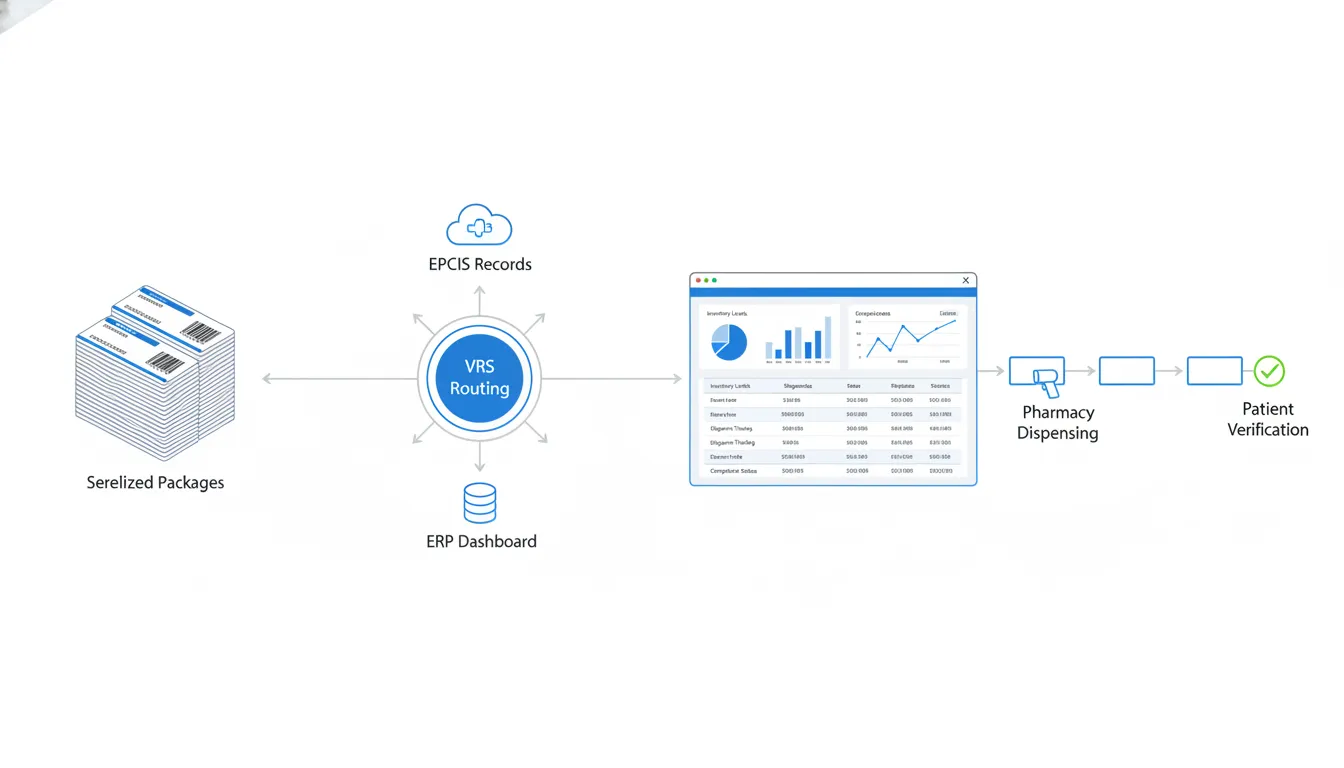
A VRS DSCSA request starts when a trading partner handles a returned serialized product. The service routes a structured verification request to the appropriate endpoint and returns a response to the requester. When connected to DSCSA compliance software, that response can support exception review, inventory control, and audit evidence.
The request path.
- Scan the returned product. The receiving team captures the package identifier from the saleable return.
- Route the verification request. The VRS network uses the identifier and partner data to send the request to the right source.
- Receive the response. The manufacturer endpoint or authorized source returns the verification result.
- Record the outcome. The receiving workflow stores the response, related product data, and return status.
- Resolve exceptions. A mismatch, unreadable barcode, missing response, or stale partner record moves into review.
Exception handling.
A no-match is not a reason to force the return through the normal path. The operator should hold the product for review and keep the VRS result with the case. The same approach applies when a barcode does not scan as expected or when partner data appears incomplete.
Schedule a VRS DSCSA workflow review with RxERP before you commit to another disconnected compliance tool..
VRS, EPCIS, and ERP: what each system should handle.
VRS matters, but it is not the whole compliance architecture. Buyers should treat VRS, EPCIS or DSCSA transaction data, and serialized ERP designed for pharma supply chains as connected layers. Each layer has a distinct job, and the handoffs between them determine whether staff can act with confidence.
Role comparison.
| Decision point. | VRS. | EPCIS or DSCSA data. | Serialized ERP. |
|---|---|---|---|
| Primary job. | Route verification requests. | Support standardized transaction records. | Run serialized operational workflows. |
| Trigger. | A returned product needs verification. | A product changes hands or status. | Staff receive, move, sell, return, or review inventory. |
| Output. | A verification response. | A traceability record. | An auditable business action. |
| Risk. | Routing is mistaken for full compliance. | Records sit outside daily work. | The ERP lacks native serialization logic. |
Connected records.
The ERP should connect the VRS result to the return, item, lot, serial number, trading partner, and final disposition. That is where a pharma-native platform becomes important. RxERP is built around serialized inventory, returns, compliance records, and operational execution in one environment.
What should buyers look for in a VRS-ready ERP?
A VRS connection is one part of the buying decision. Buyers also need an ERP that keeps serialized product data tied to daily work. The goal is a clear path from verification request to reviewed, recorded result across receiving, inventory, returns, compliance review with an end-to-end compliance solution for pharma distributors, and management reporting.
Demo the full return, not just the response.
Start with a workflow demo. Ask the vendor to show a saleable return from scan through verification response and final disposition. Then ask how the same serialized record appears during receiving, shipping, return review, inventory visibility, and audit preparation.
- Staff view: Where does a VRS result appear for the person handling the return?.
- Record connection: How does the platform connect transaction data with inventory status?.
- Exception path: What happens when a request needs review instead of a routine response?.
- Customer fit: Does the workflow support wholesalers, 3PLs, virtual manufacturers, specialty pharmacies, and other groups listed on who we serve?.
Look for pharma-native controls.
Generic ERP platforms often need extra systems or custom work to manage serialization, product tracing, returns, and DSCSA documentation. RxERP’s fully serialized ERP approach keeps unit-level product identity inside the workflows teams already use for purchasing, receiving, inventory, sales orders, pick/pack/ship, returns, and reporting.
Common VRS DSCSA implementation mistakes to avoid.
A VRS DSCSA rollout can fail even when the router responds as expected. Saleable returns verification touches product records, barcode capture, exception handling, user permissions, and proof for later review. The biggest risks come from treating VRS as a separate tool and leaving the final decision outside the ERP.
Mistake 1: treating VRS as the whole strategy.
VRS supports verification routing. It does not replace transaction management, inventory controls, partner validation, or exception ownership. Teams still need a clear process for what staff should do after a match, no-match, unreadable scan, or missing response.
Mistake 2: skipping exception testing.
A polished routine demo is not enough. Buyers should test realistic failure states before rollout. That includes unreadable barcodes, conflicting product data, inactive partner records, and delayed responses. It also includes returns that need supervisor review before final disposition.
- Exception evidence: Record the reason, owner, status, and outcome for each exception.
- Retesting: Retest corrected workflows before staff use them on live returns.
- Audit readiness: Confirm that the evidence is searchable and tied to the product record.
How RxERP keeps VRS DSCSA work connected.
RxERP is built for pharmaceutical operations where serialization, compliance, inventory, and financial workflows cannot live in separate tools. For VRS DSCSA work, that means the verification result can support the return process without losing the surrounding product history.
Serialized data inside daily work.
RxERP tracks item and NDC master data, lot and expiration dates, and serialized inventory. It also supports purchasing, sales orders, pick/pack/ship activity, and returns processing. Those records are part of the operational workflow, not a separate compliance archive that staff need to reconcile later.
This matters when a saleable return needs review. The team should see the serialized product record, the return, the verification outcome, and the next allowed action in one place. That reduces manual handoffs and gives managers a clearer record when questions come up later.
Compliance-first ERP controls.
RxERP’s DSCSA compliance capabilities include product tracing, EPCIS and ASN handling, and trading-partner management. They also support T3 report generation, audit readiness, and chain-of-custody records. The platform is designed for wholesalers, 3PLs, virtual manufacturers, specialty pharmacies, repackagers, relabelers, and state stockpiling programs.
For buyers comparing VRS options, the key question is whether the ERP can turn the verification response into a controlled business action. RxERP helps teams connect that response to serialized inventory, exception handling, and reporting so DSCSA work supports operations instead of slowing them down.
Frequently Asked Questions.
These questions summarize the buyer issues that usually appear when teams compare VRS providers, DSCSA compliance systems, and ERP platforms. Use them to frame a practical demo and avoid confusing verification routing with the broader operational workflow your team needs to run every day.
How does VRS help wholesalers and manufacturers manage saleable returns?
VRS helps route a serialized product verification request to the appropriate manufacturer endpoint and return a response to the requesting trading partner. For wholesalers, it supports the return decision. For manufacturers, it reduces manual handling of routine verification requests.
Is VRS mandatory for every DSCSA verification request?
VRS is most often discussed for saleable returns verification and suspect-product verification workflows. Buyers should review current FDA guidance and trading partner requirements. They should also confirm provider network expectations before deciding how VRS fits into their DSCSA process.
What is the difference between VRS, EPCIS, and serialized ERP?
VRS routes verification requests, EPCIS supports standardized transaction event data, and serialized ERP connects those records to daily receiving, inventory, returns, sales, and audit workflows. The systems should work together rather than operate as separate compliance silos.
What should buyers ask during a VRS DSCSA software demo?
Ask the vendor to show a saleable return from scan through verification response. The demo should include exception review, final disposition, and the audit record. The demo should show where staff see the result and how serialized product records stay connected across the ERP.
Use the same checklist for provider comparisons, internal process design, and staff training. It keeps the conversation grounded in daily work, not only compliance language.
How to prepare your team for VRS DSCSA changes.
Preparation should begin before a shipment or return creates pressure. Build a simple map of the current return workflow, the systems staff use, and the records that prove each step was completed.
Start with current-state mapping.
List who scans the returned product, who reviews exceptions, and who decides whether inventory can move back into saleable stock. Then compare that workflow with the VRS response path. Gaps often appear where teams move from a compliance tool back into daily ERP work.
Define ownership before go-live.
Assign clear owners for master data, partner records, exception review, and audit documentation. A VRS DSCSA workflow is easier to manage when each team knows what to check, when to pause, and where to record the final decision.
Ready to simplify saleable returns verification?
Delaying a VRS review can leave saleable returns tied up in avoidable verification questions and disconnected handoffs. Starting now gives your team time to clarify the workflow before small gaps create larger operational delays. A structured review can also show where a pharma-native, serialized ERP can reduce friction.
RxERP brings DSCSA-first traceability, serialized inventory, returns, sales, financial workflows, and reporting into one platform. It supports pharmaceutical distributors, 3PLs, virtual manufacturers, specialty pharmacies, and related supply chain teams.
Schedule a demo with RxERP to review your VRS DSCSA workflow and see how saleable returns verification can fit into a connected serialized ERP..