
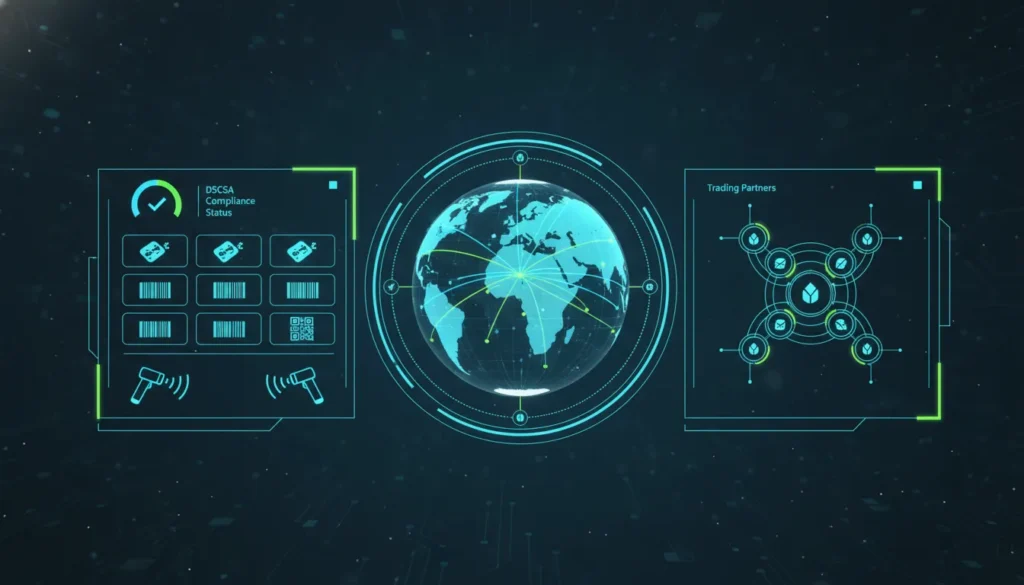
EPCIS DSCSA work is not just a technology file exchange. It is an operating requirement that touches product data, inventory events, trading partner records, compliance review, and audit response. For pharmaceutical distributors, 3PLs, virtual manufacturers, specialty pharmacies, micro-distributors, and government programs. The real question is simple: can the ERP support serialized traceability without forcing teams to stitch together point tools and spreadsheets?
Schedule a Demo to see how RxERP connects serialized ERP, DSCSA workflows, inventory, reporting, and trading partner operations in one pharma-native platform.
The DSCSA requires interoperable electronic tracing across the prescription drug supply chain. EPCIS gives trading partners a common GS1 language for sharing product movement events. But a valid exchange depends on the quality of the operational data behind it. If item records, location data, shipment events, returns, and partner identifiers live in separate systems, EPCIS becomes harder to trust.
This guide explains what EPCIS for DSCSA means from an ERP perspective. It focuses on what trading partners need from the system that runs daily operations, not only what a standalone serialization tool can export.
What EPCIS DSCSA compliance actually requires from trading partners
EPCIS stands for Electronic Product Code Information Services. In the DSCSA context, it is the GS1 standard used to capture and share events tied to serialized pharmaceutical products. Those events help trading partners exchange required product tracing data in a consistent electronic format.
The practical goal
The goal is traceability at the package level. Each serialized product must be linked to the right product identity, lot, expiration date, transaction context, and movement event. The data also needs to travel between authorized trading partners without losing meaning.
That is why EPCIS is more than a document. It describes the what, when, where, why, and how of product movement. A shipment event, receive event, aggregation event, or exception event has business meaning. The ERP must preserve that meaning as inventory moves through the operation.
Who this affects
DSCSA product tracing duties apply across the pharmaceutical supply chain, including manufacturers, repackagers, wholesale distributors, and dispensers. Each group may have different workflows, but all rely on clean product and partner data. If the data is incomplete, even a well-built EPCIS connection can create exceptions.
That is why trading partners need more than a data pipe. They need an operations system that can show which product moved, who handled it. Where it moved, what transaction triggered the move, and whether the record is ready for audit review.
Why ERP ownership matters
Many teams first view EPCIS as an IT task. In practice, it also belongs to operations, compliance, warehouse, customer service, and finance teams. The ERP is where those teams meet. Orders, shipments, receiving, inventory adjustments, returns, credits, and partner relationships all create data that can affect DSCSA traceability.
A pharma-native ERP helps reduce the gap between compliance data and the work that creates it. RxERP is built for this kind of serialized supply-chain control, which is why the platform connects ERP. Compliance, inventory, business intelligence, and financial workflows instead of treating DSCSA as an isolated add-on.
Why ERP data becomes the foundation for EPCIS exchange
EPCIS messages are only as reliable as the data behind them. A file can be technically valid and still cause business problems if the ERP data is stale, incomplete, or split across too many tools. Trading partners need ERP records that match the real flow of serialized product.
Product and serialization data
The ERP must keep product identity, item setup, NDC details, serial numbers, lot numbers, expiration dates, and quantities aligned. These records are not static reference data. They affect receiving, allocation, picking, shipping, returns, and exception handling every day.
If serialization data sits outside the ERP, users may not see a mismatch until a shipment is blocked or a partner rejects a message. A unified system gives operations and compliance teams one place to review the product record before the issue spreads.
Partner and location data
EPCIS exchange also depends on accurate trading partner and location records. Global Location Numbers, ship-from locations, ship-to locations, warehouses, customer accounts, supplier records, and 3PL sites must map to the right business relationship. A small mismatch can create a large downstream exception.
ERP ownership matters here because partner data changes. New accounts are added. Locations close. A 3PL may handle inventory for several clients. Government programs may require clear audit records. The ERP should make those relationships visible and controlled.
Business context behind each event
Serialized movement events need business context. A ship event should connect to an order. A receive event should connect to a purchase record or transfer. A return should connect to customer, inventory, and financial workflows. This context helps users understand whether a traceability event reflects normal movement or a risk that needs review.
RxERP’s approach is to bring serialized traceability into the core ERP. That helps teams avoid the cost and risk of stitching together generic ERP modules, DSCSA point tools, WMS data, CRM records, and spreadsheets.
What data is required in an EPCIS file for DSCSA?
An EPCIS file for DSCSA should carry the data needed to describe serialized product movement between trading partners. Exact implementation details vary by relationship, standard version, and partner onboarding rules. Still, the core data groups are consistent enough for ERP buyers to plan around them.
Product identity
Product identity data can include the product name, dosage form, strength, NDC, GTIN or related product identifier, serial number, lot number, expiration date, and quantity. These fields help the receiver know what product is moving and which serialized units are tied to the transaction.
This is where ERP accuracy matters. If an item master is wrong, the EPCIS output may be wrong. If a serial number is not tied to the right lot or shipment, teams may face an exception that takes time to unwind.
Event details
EPCIS is event based. A message may describe when a product was packed, shipped, received, commissioned, aggregated, disaggregated, or otherwise handled. The event details can include timestamps, locations, business steps, dispositions, source and destination data, and other context.
These fields should match the real workflow. If warehouse users scan a product at the wrong step. Or if the ERP does not capture the event in the right place, compliance teams may not have the record they expect.
Transaction and statement context
DSCSA also centers on Transaction Information and Transaction Statement requirements. In practice, trading partners need a way to connect product tracing data with the business transaction. That connection helps show what changed hands and why the transfer was valid.
For deeper background on the law itself, RxERP’s guide to what DSCSA means for the drug supply chain explains the broader compliance framework. This article narrows the focus to the ERP data layer that supports EPCIS exchange.
What is the difference between EDI 856 and EPCIS?
EDI 856 and EPCIS both help trading partners exchange shipment-related data, but they do different jobs. Confusing them can lead teams to believe they are ready for DSCSA when they only have part of the picture.
Shipment notice versus serialized event data
An EDI 856 is commonly used as an advance ship notice. It tells a trading partner that a shipment is coming and describes shipment-level details. EPCIS focuses on serialized product events and traceability context. It can show how specific packages moved through the supply chain.
| Area. | EDI 856. | EPCIS for DSCSA. |
|---|---|---|
| Main role. | Advance ship notice. | Serialized event exchange. |
| Typical focus. | Shipment and order details. | Product identity and movement events. |
| Compliance fit. | Supports shipment communication. | Supports product tracing. |
| ERP need. | Order and shipment links. | Serialized inventory and audit reports. |
Why many teams need both
For many operations, the right answer is not EDI 856 or EPCIS. It is both, connected to the ERP. Shipment notices help supply-chain partners plan receiving. EPCIS data helps them trace serialized product movement in a DSCSA-ready format.
When these workflows are not connected, users may see two versions of the same shipment. The shipping team may trust the ASN, while the compliance team works from a separate traceability tool. An integrated ERP reduces that split and gives teams one operational record to review.
ERP capabilities trading partners should expect for EPCIS DSCSA workflows
Trading partners should evaluate EPCIS readiness by looking at ERP capabilities, not only by asking whether a vendor can send or receive a file. A DSCSA-ready ERP should make serialized work easier to run, monitor, and prove.
Serialized inventory management
The ERP should manage serialized inventory from receipt through shipment, transfer, adjustment, quarantine, return, and disposition. Users should be able to see which serialized units are available, where they are located, and which transaction or event is tied to them.
This is the role of a serialized ERP. It gives operations teams visibility without forcing them to leave the system of record. It also helps compliance teams trace an issue back to the business event that caused it.
Exception handling and audit review
DSCSA work creates exceptions. A trading partner may reject data. A serial number may not match. A location identifier may be missing. The ERP should help teams route, review, resolve, and document those issues without relying on informal notes.
Audit readiness depends on evidence. Teams need reports that show product movement, user actions, partner exchange status, and exception history. A compliance dashboard is useful only when it reflects live operational data.
Business intelligence and financial linkage
Serialized traceability affects more than compliance. It can affect order release, invoice timing, credit handling, shortage claims, returns, and customer service. Business intelligence should help leaders see trends in exceptions, partner performance, inventory movement, and process delays.
RxERP connects compliance with ERP, inventory, financial automation, CRM, eCommerce, and reporting workflows. That structure is important because DSCSA data does not live in a vacuum. It is part of the same operation that buys, stores, sells, ships, invoices, and reports on pharmaceutical products.
Learn more about DSCSA compliance software that is built around pharma operations, not bolted on after the fact.
How should trading partners prepare their ERP for EPCIS onboarding?
EPCIS onboarding is smoother when the ERP is ready before partner testing starts. The work is cross-functional, so it should not sit only with IT. Operations, compliance, warehouse, finance, and partner management teams all have data to validate.
- Clean master data. Review item records, product identifiers, lot controls, serial number rules, units of measure, and expiration logic. Fix weak records before they appear in partner testing.
- Map trading partners and locations. Confirm customer, supplier, 3PL, ship-from, ship-to, and warehouse identifiers. Make sure each record points to the right legal and operating relationship.
- Validate serialized event capture. Test receiving, picking, packing, shipping, returns, transfers, and exceptions. Confirm that each event is captured in the right workflow step.
- Test exchange workflows. Send and receive test data with priority partners. Review both technical validation and the business meaning of each event.
- Monitor exceptions and audit reports. Build a process for rejected files, missing data, user corrections, and management review. The goal is a repeatable control, not a one-time project.
Keep the scope tied to ERP readiness
Many EPCIS guides focus on implementation steps. ERP readiness is narrower and more operational. It asks whether the system of record can support the data quality, user workflow, exception management, and reporting that trading partners need every day.
For organizations serving multiple buyer types, RxERP’s Who We Serve page shows how distributors, 3PLs, manufacturers, specialty pharmacies, micro-distributors, and public-sector programs can share one pharma-focused operating backbone.
Common failure points when EPCIS is separated from ERP
Standalone DSCSA tools can solve a narrow exchange problem, but they may create operational gaps when they are not tied to the ERP. The risk is not only technical. It is the loss of business context.
Duplicate entry and mismatched records
When users update partner data in one tool and shipment data in another, mismatches appear quickly. A customer address may be current in the ERP but stale in the DSCSA tool. A product may be active in inventory but missing from the traceability platform.
These gaps create exception work. They also make it harder to know which record is authoritative. Teams spend time reconciling systems instead of improving the process that created the issue.
Blind spots in exception queues
An exception queue is useful only when users can see the order, shipment, inventory, and partner context behind the alert. If the compliance tool only shows a file error, operations may need to search several systems to understand the cause.
ERP-connected exception handling gives teams a better path. They can see the business event, fix the source data, document the action, and reduce the chance that the same issue happens again.
Weak audit and leadership visibility
Audit response is harder when evidence is scattered. Leaders also lose visibility into trends. They may know that files failed, but not which warehouse, partner, product group, or process step caused the problem.
A unified ERP creates a cleaner record. It connects serialized events with business workflows and gives leaders the reporting they need to manage risk. That is the operational value behind RxERP’s pharma-native model.
Frequently asked questions about EPCIS DSCSA and ERP
What is EPCIS in DSCSA?
EPCIS is a GS1 standard used to capture and share product movement events. Under DSCSA, it supports interoperable electronic exchange of serialized product tracing data between pharmaceutical trading partners.
How does EPCIS satisfy DSCSA requirements?
EPCIS helps trading partners exchange structured data about serialized products, locations, business steps, and transaction context. It supports traceability by giving partners a shared format for product movement events.
What data is required in an EPCIS file for DSCSA?
Common data includes product identity, serial number, lot, expiration date, quantity, event timestamps, location details, business steps, transaction information, and transaction statement context. Partner onboarding rules can add more detail.
What is the role of GLNs in EPCIS and DSCSA?
Global Location Numbers help identify trading partners and locations in a standardized way. They reduce ambiguity when EPCIS data moves between manufacturers, distributors, 3PLs, dispensers, and other partners.
Do trading partners need ERP and EPCIS integration?
Yes, in most mature operations. Integration helps connect serialized events with orders, inventory, shipments, returns, partner records, reporting, and audit evidence. That reduces manual reconciliation and improves control.
Schedule a demo of RxERP for EPCIS DSCSA readiness
EPCIS DSCSA workflows depend on clean data, clear ownership, and a system that connects compliance with daily operations. RxERP gives pharmaceutical trading partners a pharma-native ERP for serialized traceability, DSCSA control, inventory, finance, CRM, eCommerce, and business intelligence.
Schedule a demo to see how RxERP can help your team reduce fragmented systems and build a stronger serialized operations backbone.