Choosing among software solutions for pharmaceutical industry operations is not a simple feature comparison. The decision affects serialized traceability, inventory control, financial accuracy, customer service, and audit readiness. Leaders must determine whether specialized point tools can operate as a reliable stack or whether a pharma-native ERP should become the operational system of record.
Schedule a demo to see how RxERP unifies pharmaceutical supply chain operations.
A point solution can solve a narrow requirement effectively. A pharma-native ERP connects regulated product movement with the commercial and financial transactions behind it. The right architecture depends on process complexity, partner obligations, integration reliability, and the cost of reconciling data across systems.
What software solutions does the pharmaceutical industry need?
Pharmaceutical supply chain organizations need systems that coordinate product identity, inventory status, trading-partner data, orders, finance, quality workflows, and reporting. The critical requirement is not the number of applications. It is whether those applications preserve trustworthy data and support controlled execution from receipt through disposition.
Core capabilities across the regulated product lifecycle
A distributor, 3PL, virtual manufacturer, or specialty pharmacy may use applications for warehouse execution, serialization, regulatory compliance, accounting, CRM, ecommerce, and analytics. Each application can perform its assigned function, but the architecture must also maintain clear ownership of master data, transaction status, and exceptions.
- Serialized traceability: Capture and exchange product identifiers and transaction data at the appropriate unit and case levels.
- Inventory control: Maintain lot, expiration, location, ownership, and disposition status without losing the operational context.
- Compliance workflows: Support investigations, exceptions, documentation, and audit evidence within governed processes.
- Commercial operations: Connect purchasing, sales, customer records, and order fulfillment to the same trusted product data.
- Financial controls: Reconcile physical movement with invoicing, costs, receivables, and reporting.
- Business intelligence: Give decision-makers timely insight without requiring repeated spreadsheet reconciliation.
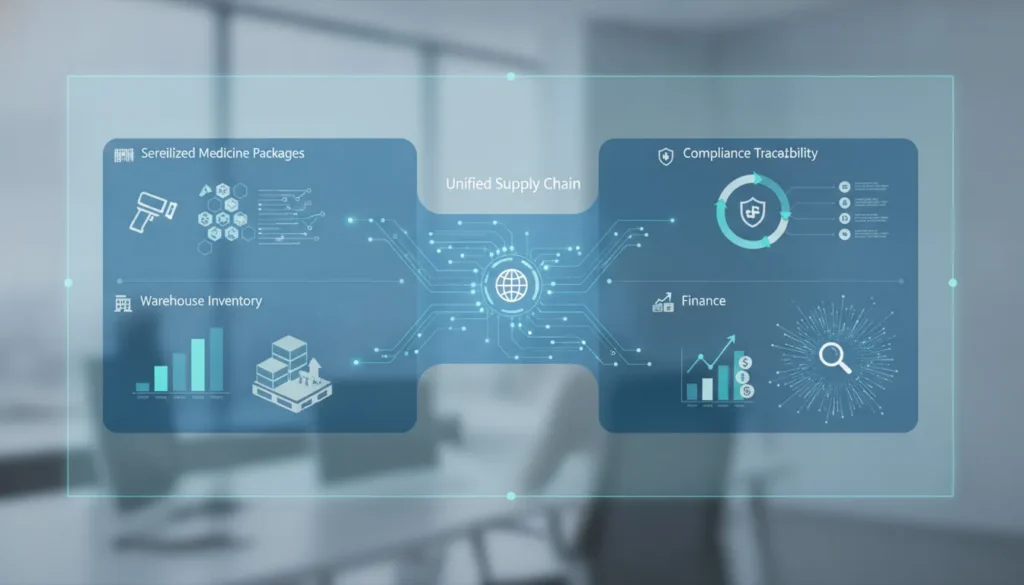
The RxERP feature set brings these operational domains into a single pharma-focused platform. That approach differs materially from a general ERP connected to separate serialization and warehouse tools.
Pharma ERP vs point solutions: what is the difference?
A point solution optimizes a defined process or compliance requirement. A pharma-native ERP coordinates multiple processes through a shared data model and transaction framework. Point tools can deliver depth, while an ERP can reduce the handoffs and reconciliation work created between specialized systems.
| Decision area | Point-solution stack | Pharma-native ERP |
|---|---|---|
| Data ownership | Distributed across applications | Shared operational system of record |
| Serialization context | Often separate from orders and finance | Connected to inventory and transactions |
| Change management | Requires coordinated vendor releases | Managed within one platform roadmap |
| Exception handling | May require cross-system investigation | Uses connected transaction history |
| Reporting | Depends on integrations or a data layer | Draws from unified operational data |
| Best fit | Stable, narrow, well-integrated use case | Complex regulated operations seeking consolidation |
When point tools remain appropriate
Specialized tools remain useful when a capability is highly differentiated, the integration boundary is controlled, and the operating team can govern the resulting data flow. A business should not consolidate solely to reduce application count. It should consolidate when fragmented execution creates measurable risk, cost, or delay.
What makes an ERP pharma-native?
A pharma-native ERP treats serialization, product status, trading-partner requirements, and regulated workflows as foundational transaction concepts. They are not sidecar functions attached after implementation. RxERP positions its serialized ERP around that connection between traceability and daily operations.
Why serialized traceability changes the software decision
Serialized traceability turns integration quality into an operational control. When product identifiers, inventory events, and commercial transactions sit in different systems, teams must prove that each transfer was complete, timely, and correctly interpreted. That increases the scope of exception management and audit preparation.
Compliance data must remain operationally useful
The Drug Supply Chain Security Act requires interoperable electronic tracing and verification capabilities across the prescription drug supply chain. For an overview of the regulatory framework, review what DSCSA is and the FDA’s DSCSA resources.
Compliance cannot be treated as an isolated reporting exercise. Serialized events must correspond to physical inventory, transaction status, and the responsibilities of authorized trading partners. If those contexts diverge, an organization may have data without having reliable control.
Exception handling exposes architecture weaknesses
Routine transactions rarely reveal the full cost of fragmentation. Exceptions do. A suspect-product investigation, ownership discrepancy, or receiving variance may require staff to reconstruct events across warehouse, serialization, order, and financial applications. Integrated DSCSA compliance software can reduce that investigative burden by preserving connected records.

How should pharmaceutical companies evaluate software?
Evaluate software against controlled workflows, data ownership, integration failure modes, and total operating cost. Feature lists matter, but they do not reveal whether the proposed architecture can maintain trustworthy records when transactions change, exceptions occur, or regulatory requirements evolve.
- Map critical workflows. Document receipts, transfers, shipments, returns, investigations, billing, and reporting from start to finish.
- Identify systems of record. Assign ownership for product, partner, inventory, order, serialization, and financial data.
- Test exception scenarios. Evaluate discrepancies and reversals, not just standard demonstrations.
- Assess integration controls. Determine how failures are detected, resolved, documented, and reconciled.
- Measure manual effort. Quantify spreadsheet work, duplicate entry, and audit preparation.
- Review governance. Confirm access controls, change management, validation needs, and evidence retention.
- Model total cost. Include implementation, interfaces, support, upgrades, and internal administration.
Apply the evaluation to each operating model
A 3PL must consider client segregation, ownership, billing, and reporting. A virtual manufacturer must coordinate external production while preserving visibility and control. Government programs may prioritize accountability, secure collaboration, and program-level reporting. The requirements differ, but each buyer benefits from evaluating the complete operating model rather than one department’s feature list.
Require evidence during vendor demonstrations
A controlled evaluation should require vendors to demonstrate realistic transactions with representative data. Ask each vendor to process a receipt, serialized shipment, return, discrepancy, investigation, and financial correction. Then review the resulting audit trail, user permissions, reports, and exception queues. This approach reveals how the product behaves when a transaction changes after its initial entry.
Buyers should also document assumptions about integrations, implementation services, validation responsibilities, and ongoing support. A polished demonstration can hide manual steps performed outside the application. Written scenarios and acceptance criteria give procurement, operations, compliance, finance, and technology teams a shared basis for comparing proposals.
A sound scorecard makes tradeoffs visible. It also helps the selection team separate mandatory controls from useful enhancements and compare implementation risk on equal terms.
The hidden cost of a fragmented pharma software stack
The cost of fragmentation extends beyond software licenses. It includes interface maintenance, reconciliation, duplicate administration, delayed decisions, and control gaps. These costs often remain distributed across departments, which makes the stack appear less expensive than it is.
Integration debt compounds over time
Each connection has mappings, monitoring, error handling, security requirements, and release dependencies. As vendors update their products, the organization must confirm that integrations continue to preserve both technical and business meaning. A change that looks minor in one application can affect multiple downstream processes.
Manual reconciliation is a control issue
Spreadsheets can help analyze exceptions, but they are a weak substitute for connected transactional controls. Repeated manual reconciliation consumes expert time and creates another layer of records to govern. It also delays visibility for operations and executive teams.
Audit readiness should be continuous
Audit preparation becomes expensive when evidence must be assembled across applications. A unified system can make records easier to retrieve and interpret because the operational context remains connected. RxERP’s compliance capabilities are designed to connect control with execution rather than treat evidence as an after-the-fact exercise.
Where a pharma-native ERP creates operational leverage
A pharma-native ERP creates leverage when shared data improves multiple functions at once. A trusted receipt can inform inventory, serialized traceability, customer service, finance, and analytics without requiring each department to reconstruct the event independently.
Distributors and 3PLs
Distributors need control over product movement, orders, customers, and financial outcomes. 3PLs add client ownership, service obligations, and billing complexity. A unified platform can reduce handoffs between warehouse activity, serialized records, and commercial reporting while preserving accountability.
Virtual manufacturers and specialty operations
Virtual manufacturers coordinate activities performed by external partners and need reliable visibility without owning every physical process. Specialty pharmacies and micro-distributors often manage high-value inventory and complex workflows with lean teams. Connected data can support faster decisions without expanding a fragile application stack.
Government and state initiatives
Government buyers and state initiatives may require transparent reporting, secure coordination, and strong stewardship of life-critical products. A platform should support program oversight while fitting the operational responsibilities of participating supply chain organizations.
When is it time to consolidate point tools?
Consolidation is warranted when fragmented systems consistently impede control, service, or decision-making. The trigger is not an arbitrary number of applications. It is evidence that maintaining the boundaries between them costs more or creates more risk than a unified operating model.
Signals that justify a consolidation business case
- Teams repeatedly reconcile the same transactions across departments.
- Exceptions require prolonged investigation across several applications.
- Integration failures are detected by users rather than monitoring controls.
- Reporting depends on manual extracts that arrive too late for action.
- Vendor upgrades regularly disrupt interfaces or delay improvements.
- Audit preparation requires a recurring, organization-wide evidence exercise.
Consolidate with control, not urgency
A responsible transition starts with process mapping, master-data governance, integration inventories, and measurable acceptance criteria. Teams should sequence migration around business risk and validate critical workflows. RxERP can provide a unified destination, but the implementation plan must respect each organization’s regulatory obligations and operating realities.
Frequently asked questions
Which software tools are needed for pharmaceutical compliance management?
The required tools depend on the organization’s role and operating model. Most teams need controlled capabilities for serialized traceability, inventory, partner data, exception management, documentation, and reporting. The architecture must also demonstrate how data moves between tools and how failures are governed.
What are the benefits of pharmaceutical supply chain software?
Effective pharmaceutical supply chain software improves product visibility, transaction control, exception response, and audit readiness. When the software connects operational and compliance data, it can also reduce reconciliation work and give leaders more timely insight into performance and risk.
What is pharmaceutical ERP software?
Pharmaceutical ERP software coordinates core business processes such as inventory, orders, customers, finance, and reporting while accounting for regulated product workflows. A pharma-native ERP also embeds industry-specific concepts such as serialization and traceability into its operational data model.
How does software streamline pharmaceutical manufacturing?
Software can coordinate materials, partners, inventory status, quality records, orders, and financial transactions. For virtual manufacturers, it can improve visibility across outsourced operations. The strongest results come from governed workflows and reliable data exchange, not automation alone.
Build a more controlled pharmaceutical software architecture
The ERP-versus-point-tool decision should begin with operating risk, data ownership, and the cost of fragmented execution. Point solutions remain valuable where specialized depth is essential and integrations are well governed. A pharma-native ERP becomes compelling when the organization needs serialized traceability, inventory, commercial operations, and finance to work from a shared source of truth.
RxERP is built by pharma for pharma to unify those responsibilities in one platform. The objective is not consolidation for its own sake. It is a more controlled, visible, and scalable operating model for organizations moving life-critical products.
Schedule a demo with RxERP to review your current software stack and consolidation priorities.