
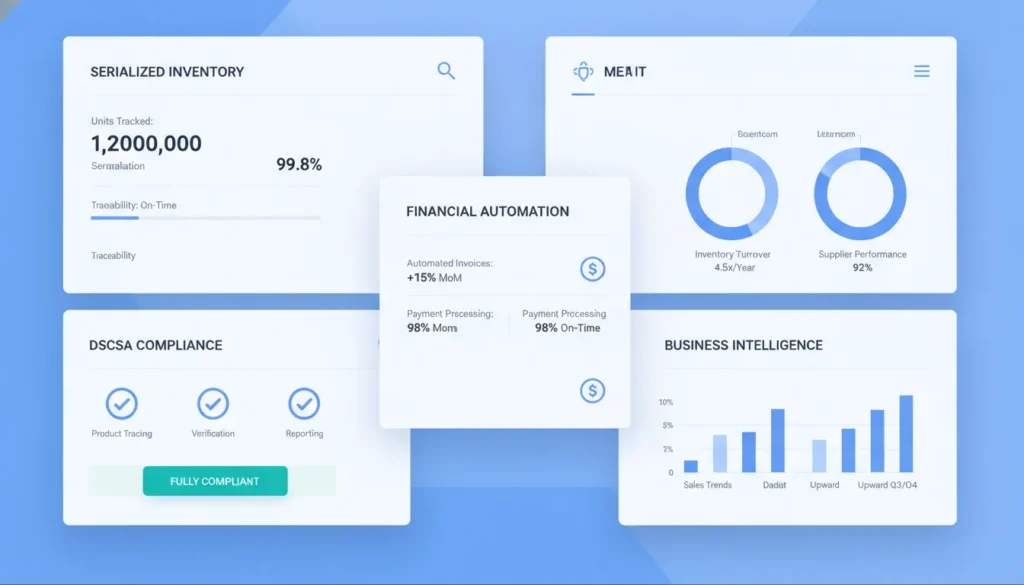
The wrong pharmaceutical ERP can turn every audit, recall, and shipment exception into a systems-integration problem. Buyers need proof that compliance and operations work together before they compare feature lists.
ERP for pharmaceutical companies is specialized operations software that connects finance, inventory, supply chain, reporting, compliance, and serialized traceability in one controlled system. A credible platform should manage serial numbers, DSCSA data exchange, audit trails, recalls, and product movement without leaving teams to reconcile separate point solutions.
This matters because the FDA requires trading partners to provide, receive, and maintain prescription-drug ownership documentation electronically as products move from manufacturer to dispenser. That makes operational fit more important than a long feature list or a familiar enterprise software brand.
Buyers should test those requirements in live workflows. Then they should compare implementation burden, integrations, reporting depth, scalability, user controls, vendor expertise, and total cost.
Choosing the best fit starts with a practical question: can the system control regulated product movement while giving finance and operations one reliable record? ERP for pharmaceutical companies: what buyers are really comparing separates pharma-native capability from features that only look complete in a sales deck. Here’s how.
ERP for pharmaceutical companies: what buyers are really comparing
ERP for pharmaceutical companies is an operating system for managing regulated products, transactions, and data across the business. It connects inventory, purchasing, sales, finance, and reporting with the controls needed for pharmaceutical work. Buyers are not simply choosing accounting software. They are deciding how the company will track products, prove compliance, and manage daily operations.
Operational control beyond accounting
A standard ERP can record orders, invoices, payments, and stock levels. A pharma buyer must also ask what happens around each transaction. Teams need to know which serialized product moved and where it went. They must also know who handled it and whether the required records remain complete.
This need changes the buying criteria. The FDA explains that DSCSA requires trading partners to provide, receive, and maintain drug ownership records across the supply chain. As a result, traceability and record exchange cannot sit apart from warehouse and order workflows.
- Compliance: Can the system support controlled workflows, clear records, and audit readiness?
- Serialization: Can teams manage serial numbers and package-level events within normal transactions?
- Supply-chain visibility: Can users trace product movement without reconciling several systems?
- Finance: Do product, customer, order, and payment records stay aligned?
- Reporting: Can leaders see useful operational and compliance data without manual spreadsheet work?
Pharma-native ERP versus add-on stacks
The core difference is where pharmaceutical controls live. A pharma-native ERP builds serialization, compliance, inventory, finance, and reporting into one operating model. A generic ERP often needs separate point solutions for traceability, compliance, or warehouse tasks. Each added system creates another integration, data handoff, and owner to manage.
That distinction affects more than the software list. Buyers should compare how an order moves from receipt through fulfillment, invoicing, and reporting. They should also test whether one transaction updates serial, inventory, customer, and financial records together. A unified serialized ERP for pharma shows how those linked workflows differ from a patched stack.
The real buyer comparison
A useful review starts with business scenarios, not a broad feature checklist. Ask each vendor to show a serialized receipt, sale, return, exception, and audit request. Then note how many systems, exports, and manual steps each scenario requires.
Buyers should also compare control after launch. Consider who maintains integrations, how teams resolve mismatched data, and whether reports reflect current operations. The stronger choice gives operations, compliance, supply-chain, and finance teams one reliable view. It should reduce the need to rebuild a complete record whenever a question or exception occurs.
How does a pharma-native ERP differ from a generic ERP?
A different system boundary
A generic ERP usually starts with finance, purchasing, and broad inventory controls. A pharma-native ERP starts with those functions plus the rules that govern drug movement. It connects each physical transaction to its product, serial, trading partner, and financial record.
This distinction is central when choosing an ERP for pharmaceutical companies. The FDA describes DSCSA as an electronic, interoperable approach to tracing certain prescription drugs through the United States supply chain. A system built around that work can keep traceability within daily operations instead of treating it as a separate compliance task.
A generic ERP can still support a pharma business, but it often needs a connected WMS, DSCSA point solution, CRM, spreadsheets, and finance tools. Each added system creates another data handoff, process owner, and place to reconcile records. A unified serialized ERP for pharma takes the opposite approach by keeping serialization, inventory, pricing, and order-to-cash in one operating model.
Side-by-side decision criteria
The key question is not whether each option has a feature label. Buyers should test whether a workflow runs end to end without rekeying data or switching systems. The table shows where a pharma-native platform and a stitched generic stack tend to differ.
| Decision criterion | Pharma-native ERP | Generic ERP and connected tools |
|---|---|---|
| Serialized traceability | Serial data follows receiving, inventory, orders, and returns. | A point solution often holds serial events apart from ERP records. |
| DSCSA workflows and audit readiness | Compliance records sit within routine trading-partner workflows. | Teams may reconcile records across the ERP, provider portals, and files. |
| Inventory control | Product status and serial history inform stock decisions. | A WMS may manage stock while another system manages traceability. |
| Financial automation | Operational events can flow directly into financial records. | Interfaces and manual checks connect operations with finance. |
| BI and reporting | Reports draw from one operating data model. | Reports may require combined exports from several tools. |
| CRM, eCommerce, and implementation risk | Customer channels share core product and order data. | More integrations add testing, ownership, and support needs. |
No architecture removes the need for controls or sound implementation. Yet a stitched stack places more weight on interface design and ongoing data checks. A pharma-native ERP places more weight on configuring one model for the company’s products, partners, and operating rules.
Questions for vendor demos
A useful demo should follow one serialized product through receiving, sale, shipment, return, and financial posting. Ask the vendor to show every system change, manual entry, and exception queue along that path. This reveals whether the platform supports the workflow or only displays related data.
Then test how staff prepare for an audit or investigate a mismatch. Can they trace the transaction from source event to financial impact without building a spreadsheet? Buyers can also review the vendor’s pharma ERP features for serial number management, DSCSA interoperability, and reporting before scoring the fit.
The strongest choice depends on the current stack, team skills, and integration burden. A generic ERP may fit when mature internal teams can own several connected tools. A pharma-native ERP is a closer fit when the goal is one controlled workflow across compliance, supply chain, customer operations, and finance.
What compliance and serialization capabilities should buyers expect?
Compliance should shape the core design of an ERP for pharmaceutical companies, not sit in a separate tool. Buyers need to test how the system connects product identity, inventory status, trade data, and each physical move. That link helps teams find issues before products move and creates clear evidence for an audit. A dedicated DSCSA compliance software platform connects traceability, audit trails, and inventory controls in one system.
Package-level traceability and interoperability
The DSCSA calls for interoperable electronic tracing of certain prescription drugs across the United States supply chain. It also requires trading partners to provide, receive, and maintain product documentation. Buyers can review the FDA’s DSCSA compliance policies to frame their software tests.
A capable system should manage each serial number through receipt, storage, sale, shipment, return, and other key events. Ask vendors to show how their software exchanges trace data with partners and matches it to physical inventory. The workflow should support real operations without forcing staff to switch between disconnected screens.
During a demo, use a real transaction path rather than a polished dashboard. Follow one package from inbound scan through shipment, then check its history. A unified serialized ERP for pharma should keep serialized trace data connected with orders and inventory records.
Inventory controls and exception handling
Serialization alone does not give teams enough control. Buyers should expect visibility by product, serial number, lot, location, status, and expiration date. The system should also make exceptions clear, route them to the right owner, and stop affected products from moving when review is needed.
- Test duplicate, missing, unreadable, and mismatched serial numbers.
- Check how staff place suspect or returned products on hold.
- Confirm that lot and expiration data stay linked through each transaction.
- Review alerts, ownership, notes, evidence, and resolution steps.
- Verify how corrected records flow to inventory and trade partners.
Exception tests show whether a platform supports safe product movement under pressure. They also expose gaps between warehouse work and compliance records. Buyers should ask who can clear a hold, what proof is required, and how the system prevents an unresolved item from shipping.
Audit trails and buyer proof
A strong audit trail should show what changed, who made the change, when it happened, and why. It should preserve the original event and its correction instead of hiding the history. Teams also need fast ways to find records and export clear evidence during a review.
Ask each vendor to run the same proof-based test. Start with a serial-number exception, place the product on hold, resolve it, and produce the full audit record. Then compare the result with the platform’s wider DSCSA approach and the needs of each trading partner.
The best evaluation focuses on daily control, not a feature checklist. Buyers should confirm that serialized events, inventory state, exceptions, and audit evidence remain tied together. This makes compliance work easier to verify and helps operations teams move life-critical products with care.
Which ERP modules matter most for pharmaceutical operations?
The right ERP for pharmaceutical companies connects the work that moves a product with the data that proves each step. Buyers should assess modules as one operating flow, not as a feature checklist. A strong demo should follow a serialized item from receipt through shipment, invoice, payment, and reporting.
Inventory and warehouse control
Inventory management is the core operational module because it links product identity, location, status, and ownership. Look for lot, expiration, and serial-level controls across receiving, putaway, picking, packing, shipping, returns, and recalls. The system should also prevent blocked or suspect stock from entering an order.
These controls must remain tied to electronic traceability records. The FDA describes DSCSA documentation as tracking prescription drugs and their chain of ownership from manufacturer to dispenser. Buyers can test that connection by reviewing a complete transaction in a unified serialized ERP for pharma.
- Confirm that receiving captures product and traceability data in one workflow.
- Test allocation rules for short-dated, quarantined, recalled, and restricted inventory.
- Verify that warehouse actions update available stock and compliance records at once.
- Review how the system handles saleable returns and suspect product investigations.
Commercial and financial workflows
Order-to-cash and purchasing modules should share the same item, customer, vendor, and pricing records. That link reduces rekeying between sales orders, warehouse work, invoices, receipts, and the general ledger. It also gives finance and operations a common view of each transaction.
Buyers should test pricing rules, credit controls, contract terms, chargebacks, claims, and customer management if those workflows apply. Financial automation should cover routine postings, matching, approvals, collections, and close tasks. Ask vendors to show exceptions, because clean sample orders rarely reveal gaps.
- Trace a purchase order through receipt, invoice matching, and payment.
- Trace a customer order through allocation, shipment, billing, and cash receipt.
- Test a price dispute, credit hold, return, and chargeback or claim.
- Check whether eCommerce orders use the same inventory and customer rules.
Analytics and customer visibility
Business intelligence should draw from live operational and financial data rather than separate exports. Dashboards should let leaders move from a summary to the order, item, customer, or warehouse event behind it. Useful views include inventory aging, fill rate, margin, cash, exceptions, and traceability status.
CRM and eCommerce modules matter when they share that same source of truth. Sales teams need current stock, account terms, order history, and issue status without switching systems. Customer portals should reflect the controls already set in the ERP, not create a second version of an order.
AI-powered reporting can help users ask questions and find trends, but its answers must remain tied to trusted records. During evaluation, compare access controls, drill-down paths, and the source behind each answer. RxERP’s business intelligence analytics page shows how unified data supports operational reporting.
The final comparison should focus on handoffs between modules. Every added connector creates another place for data to lag, fail, or lose context. A unified platform lowers that stitching risk by keeping operational, compliance, customer, and financial workflows together.
How should pharmaceutical buyers evaluate ERP options?
Start by defining the operating and regulatory problems the new system must solve. A useful review tests real workflows, data, controls, and reports instead of comparing feature lists alone.
Regulatory scope should lead the process because the FDA describes enhanced DSCSA security requirements at the package level. Buyers should also assess whether a unified serialized ERP for pharma can reduce handoffs between traceability, inventory, and financial systems.
Evaluation groundwork
Create a scorecard before vendor meetings begin. Give each requirement an owner, a test case, an expected result, and a clear weight based on business risk.
- Map regulatory scope. List each license, trading-partner role, product type, market, record rule, and audit need the system must support. Compliance leaders should mark which controls are required and which are preferred.
- Validate serialized workflows. Ask vendors to run receiving, aggregation, sale, return, quarantine, suspect-product, recall, and exception scenarios with realistic serialized data. Check what users see when data is missing, late, or wrong.
- Review integration needs. Map every connection to warehouses, 3PLs, trading partners, finance tools, commerce systems, carriers, and legacy databases. Document the owner, data direction, update timing, error handling, and monitoring plan for each link.
- Test reporting and audit evidence. Give each vendor the same sample data and questions. Confirm that teams can trace product movement, explain exceptions, reconcile inventory, review margins, and export audit-ready records without manual cleanup.
- Compare implementation risk. Review data migration, validation, configuration, training, testing, cutover, support, and change-control plans. Ask who owns each task, what could delay launch, and how operations continue if a key step fails.
- Involve cross-functional leaders. Operations should test daily usability, compliance should test controls, and finance should test reconciliation and reporting. IT should assess security and integration, while executives compare cost, risk, and expected value.
Proof before selection
Require vendors to show the full process, not isolated screens. A scripted proof session makes gaps visible and helps leaders compare each ERP for pharmaceutical companies on the same terms.
Score both the software and the delivery plan. Review references from firms with similar roles and volume, then test how the vendor handles exceptions, updates, and support after launch.
The final choice should link each major need to clear proof, an accountable owner, and a measured acceptance test. Buyers can use a broader business intelligence and analytics review to define reporting tests before demos begin.
What implementation risks should pharmaceutical teams plan for?
Implementation risk starts when a team treats software selection as a feature contest instead of an operating model change. An ERP for pharmaceutical companies must fit current controls, connect critical partners, and remain usable as the organization grows.
Vendor experience and workflow fit
Start by testing the vendor’s direct experience with your business model, not pharma in general. Different pharma segments handle products, ownership, exceptions, and reporting in different ways. Ask candidates to show your hardest workflows with realistic data and the staff who perform them.
The FDA says trading partners must provide, receive, and maintain drug tracing documentation as products move through the US supply chain. That raises the cost of a poor workflow fit. Confirm how each vendor maps SOPs, roles, approvals, audit trails, and exception handling before signing.
A polished demo may hide manual steps or added tools. Request a fit-gap review that names each needed change, its owner, its cost, and its effect on validation. Treat vague promises about later setup as open risks.
Data migration and integration controls
Poor source data can carry old errors into the new system. Build a migration plan for item masters, serial records, customers, vendors, inventory, open orders, financial balances, and audit history. Reconcile each load against the source. Require business owners to approve the results.
- Define which system owns each data field and when ownership changes.
- Test partner connections with valid records, errors, duplicates, delays, and outages.
- Set clear rollback rules for failed loads and cutover issues.
- Keep evidence of mapping, tests, approvals, and resolved defects.
Integration tests should cover daily work and rare but high-risk events, such as recalls, returns, and shipment exceptions. Compare the proposed design with a unified serialized ERP for pharma. Then note whether key flows stay in one system or cross weak handoffs.
User adoption and future scale
Setup alone does not change how people work. Assign process owners from operations, compliance, finance, warehouse teams, and customer service. Give each role task-based training. Then run acceptance tests with real cases and clear pass criteria.
Plan support for the first weeks after launch. Include fast issue review and a route for urgent compliance concerns. Track user errors, workarounds, delays, and support volume. These signals show where training or design must improve.
Finally, test the system against the next stage of the business, not only today’s volume. Ask how it handles new sites, partners, product lines, users, reporting needs, and rules. A phased rollout can limit disruption. Still, every phase needs owners, entry checks, and exit checks.
When is RxERP the right fit for pharmaceutical companies?
RxERP is a strong fit when a pharma business needs one operating system across regulated product movement and core business work. It suits teams that want serialized traceability, compliance, inventory, finance, sales, and reporting to share the same data. The fit is weaker when a company only needs basic accounting or a stand-alone tool for one narrow task.
Fit by business model
The platform is built for pharma distributors, 3PLs, manufacturers, specialty pharmacies, micro-distributors, and government initiatives. These groups often manage products, partners, orders, and records across several linked workflows. FDA guidance explains that trading partners must provide, receive, and maintain electronic drug tracing documentation as prescription drugs move through the US supply chain.
Distributors and 3PLs need serialized inventory tied to receiving, picking, shipping, and customer records. Manufacturers need an ERP system for drug production with compliance and serialization in the operating model.
Specialty pharmacies and micro-distributors need pharma controls without a patchwork of separate systems. Government programs need clear oversight, reporting, and control of life-critical product movement.
The operating model test
RxERP becomes more relevant as the cost and risk of disconnected tools rise. A team may be reconciling serialized events against inventory, finance, CRM, and eCommerce records by hand. That gap can slow routine work and make it harder to prepare a clear audit trail.
A good candidate wants a unified serialized ERP for pharma rather than a generic ERP plus many add-ons. The goal is not simply fewer applications. It is consistent data across compliance, business intelligence, financial automation, inventory management, CRM, and online sales.
Questions for the buying team
Before selecting RxERP, buyers should map their current workflows and define the results they need. They should also test the platform with real package, order, exception, and financial data. AI reporting and voice chat should support useful decisions, not serve as stand-alone reasons to buy.
- Can the system connect serial-level events with inventory and financial records?
- Does it support the trading partners, sites, product flows, and exceptions the business handles today?
- Can leaders get useful BI and AI-driven reports without rebuilding data in spreadsheets?
- Will CRM, eCommerce, and voice chat fit the team’s real sales and service workflows?
- Can the implementation replace enough point tools to justify its cost and change effort?
RxERP is most suitable when answers to these questions point toward one pharma-native operating platform. Companies with simple, unregulated workflows may not need that scope. Buyers should base the choice on workflow fit, compliance needs, integration effort, and the value of shared data.
Frequently Asked Questions
Which ERP is best for pharma?
The best ERP for a pharmaceutical company matches its role, workflows, compliance duties, and growth plans. Buyers should compare serialized traceability, DSCSA interoperability, audit trails, inventory controls, financials, reporting, and partner integrations. A pharma-native platform may reduce the add-ons and data handoffs required by a generic ERP. Validate every shortlisted system through real workflow demonstrations and reference checks.
What are the top five ERPs for pharmaceutical companies?
There is no universal top-five list because manufacturers, distributors, and 3PLs have different requirements. Common evaluation lists include pharma-native platforms and broader products such as SAP, Oracle NetSuite, Microsoft Dynamics 365, Infor, and BatchMaster. Buyers should score each option against required workflows rather than brand recognition. Include compliance, traceability, integration effort, implementation support, and total ownership cost in that score.
Can a generic ERP meet DSCSA requirements?
A generic ERP can support DSCSA workflows when properly configured and connected to suitable serialization and interoperability tools. However, buyers should verify package-level tracing, transaction documentation, exception handling, partner connectivity, and audit evidence before selection. The FDA states that trading partners must provide, receive, and maintain prescription drug ownership documentation electronically. Required add-ons can increase implementation effort and ongoing support needs.
How should pharmaceutical companies compare ERP implementation costs?
Compare total ownership cost, not only license fees. Include implementation services, data migration, validation, training, integrations, required add-ons, support, upgrades, and internal staff time. Buyers should also price the cost of maintaining separate compliance, serialization, warehouse, and reporting systems. Request a phased estimate tied to documented workflows, assumptions, responsibilities, and acceptance criteria so competing proposals remain comparable.
Ready to Choose a Pharma-Native ERP With Confidence?
Delaying an ERP decision keeps fragmented workflows, compliance gaps, and manual reporting in place, increasing the burden on operations teams. Starting the evaluation now gives stakeholders time to compare pharma-native capabilities, validate fit, and plan a controlled rollout before current systems create more friction. A structured comparison also helps your team select a platform that supports serialized traceability, audit readiness, inventory control, financials, and reporting together.
Ready to replace disconnected tools with one operational system? Schedule a demo to review RxERP’s serialized ERP capabilities, discuss your requirements, and build a practical path toward implementation. Use the conversation to align operations, compliance, finance, and technology leaders on what the next phase should include.