
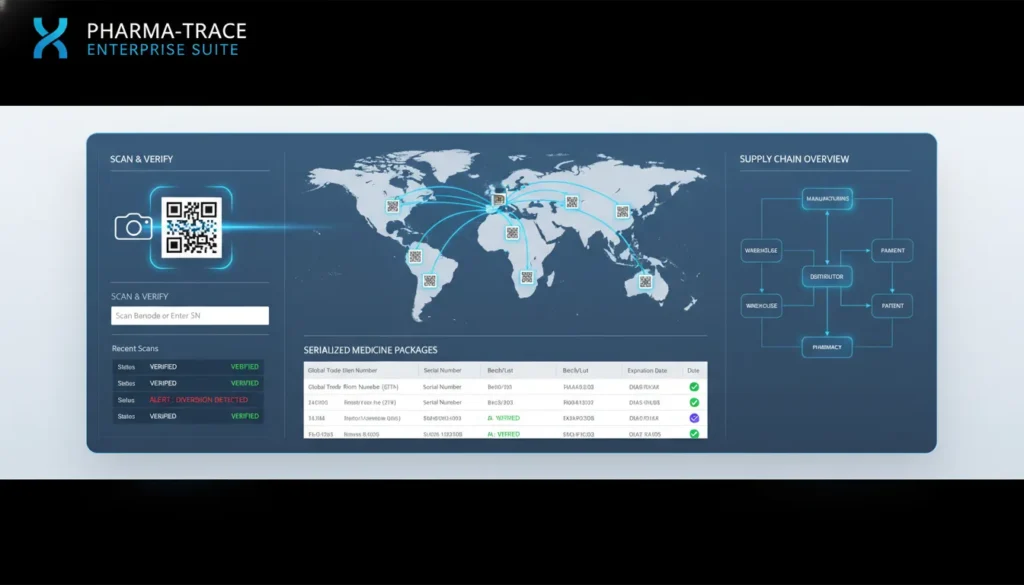
A shipment can be visible at every stop and still fail a DSCSA audit. For pharmaceutical buyers, the decisive issue is whether tracking data supports the wider compliance workflow.
Track and trace software monitors a product’s location, status, and movement through the supply chain, often using serialized identifiers and event data. In pharma, that visibility supports DSCSA compliance, but it does not automatically manage interoperable transaction data, exception handling, partner exchange, or audit readiness. DSCSA compliance software covers these wider regulatory workflows and helps supply-chain partners maintain the serialized records needed across the distribution channel. A serialized ERP goes further by connecting traceability and compliance with inventory, finance, reporting, and the daily work behind every product movement. Buyers should judge whether a platform merely shows where products moved or provides integrated controls to investigate exceptions and prove compliance without stitching systems together.
The buying question is how much operational and regulatory work the platform must carry beyond visibility. The next section, What track and trace software means in pharma, sets the baseline for comparing a tracking capability with a broader compliance system. The path begins with:
What track and trace software means in pharma
Track and trace software records where a product came from, where it went, and what happened during each handoff. In pharma, that record must follow the product itself, not just the box or truck carrying it.
This makes the software different from a parcel tracking page. Parcel tracking may show that a shipment reached a warehouse. Pharma track and trace software must connect that event to the products, lots, and serialized units inside the shipment.
From shipment status to serialized movement
Serialization gives each saleable unit a distinct identity. Track and trace software links that identity to events such as packing, shipping, receiving, and returning. A team can then trace a unit’s path without relying on a loose chain of emails and spreadsheets.
The practical goal is a trusted product history. Staff should be able to see which trading partner handled a unit and when the handoff occurred. RxERP’s guide to unit level serialization software explains how unique product identities support this level of control.
Generic shipment tracking answers, “Where is the delivery?” Pharma traceability asks more detailed questions. Which units moved, which lot they belong to, and do their records match the physical goods?
Lot, unit, and event visibility
Useful traceability connects several layers of data. Lot visibility groups products made under the same production record. Unit visibility narrows the view to one serialized package. Event data shows each change in custody or status across the distribution channel.
- Lot records: Help teams find the wider product group tied to an issue or review.
- Unit records: Show the identity and recorded path of one saleable package.
- Movement events: Capture shipping, receiving, returns, and other product status changes.
- Audit data: Preserve the details needed to review a transaction and explain what occurred.
These views matter because a shipment can arrive while its data remains incomplete or mismatched. A traceability system helps staff find that gap before it spreads into inventory, customer service, or compliance work.
Traceability inside pharma operations
Track and trace is a capability, not the whole compliance program. It records serialized movement, while broader workflows govern data exchange, exceptions, reviews, and audit readiness. The distinction becomes clearer in RxERP’s overview of DSCSA compliance and traceability.
A standalone tool may keep traceability apart from inventory, finance, and reporting. That split forces teams to reconcile separate records when a unit moves, returns, or needs review. It can also make a simple audit question harder to answer.
RxERP takes a pharma-native approach by placing serialized traceability within a unified ERP. The same product event can inform inventory status, compliance work, and business records. This approach reduces the cost and risk of stitching generic systems together.
For buyers, the key question is not whether software can display movement. The question is whether that movement stays linked to the product and its transaction data. It must also connect with the daily workflows that manage it. RxERP’s pharma compliance features show how those records fit into wider operations.
Track and trace software vs DSCSA compliance software
Track and trace software shows where a product has been and where it is moving. In a pharma supply chain, that visibility must connect each saleable unit to its unique product identifier. DSCSA compliance software uses that traceability data across a wider set of regulatory and operational workflows.
A capability versus a compliance system
Track and trace is a capability, not a complete compliance program. It records product movement and may show chain of custody, shipment status, or inventory location. A general tool can do that work without managing every rule that applies to prescription drug trading partners.
DSCSA compliance software has a broader job. It must support serialized transaction data, product verification, partner data exchange, exception handling, reporting, and audit records. These functions help teams act on traceability data instead of only viewing it.
The distinction matters because the Drug Supply Chain Security Act sets traceability duties for trading partners across the prescription drug supply chain. A location record alone cannot show that every required process was completed.
The comparison is simple. Track and trace software shows product movement. DSCSA compliance software manages the regulated work around that movement.
| Area. | Track and trace. | DSCSA compliance. |
|---|---|---|
| Purpose. | Shows product movement. | Manages regulated workflows. |
| Audit record. | Shows location history. | Shows actions and reports. |
- Primary purpose: Track and trace monitors location. DSCSA compliance manages regulated traceability workflows.
- Serialization: Track and trace may display serial numbers. DSCSA compliance connects serial data to required events.
- Exceptions: Track and trace may flag issues. DSCSA compliance routes suspect, illegitimate, and data issues.
- Audit readiness: Track and trace provides history. DSCSA compliance provides records, actions, and reports.
Operational coverage beyond visibility
A compliance platform should help a team manage the events that follow a traceability alert. Staff may need to verify a product, research a data gap, quarantine inventory, contact a trading partner, or document a response. Each action needs a clear owner and record.
Serialization is also more than storing a serial number. The system must link the identifier to products, lots, packages, transactions, and trading partners. RxERP’s guide to DSCSA serialization requirements explains the role of serialized records within the wider compliance process.
- Verification connects a scanned identifier to trusted product and transaction data.
- Exception handling turns missing, mismatched, or suspect data into assigned work.
- Reporting gives compliance teams a record of events, decisions, and follow-up actions.
- Interoperability helps trading partners exchange and use serialized transaction data.
These workflows often touch inventory, receiving, shipping, finance, and customer service. When each function lives in a separate point solution, teams must reconcile data between systems. That split can slow research and leave gaps in the audit trail.
Choosing the right scope
A basic track and trace tool may fit a narrow need, such as monitoring shipments or recording custody events. It is not enough when the business must manage DSCSA duties across daily operations. Buyers should test the full path from a serialized event to its final review and record.
That review should include verification, exception routing, partner exchange, reporting, and access to supporting records. It should also show how traceability connects with inventory and other core workflows. A unit level serialization software approach can reduce the gaps between product identity, movement, and compliance work.
The practical question is not whether software can locate an item. It is whether the system can help a team resolve the issue, prove its actions, and keep operations moving.
Where standalone traceability tools fall short
Standalone track and trace software can record a product’s movement and location. That function matters, but it does not run the full pharma operation. Risk grows when serialized events sit apart from inventory, finance, compliance, and reporting data.
Each separate system creates another handoff to manage. Teams may move the same data through exports, spreadsheets, or manual entry. A traceability record can look complete while the related stock status, invoice, or compliance case remains out of sync.
Disconnected data and duplicate work
Point solutions often organize data around serialized events instead of business transactions. Warehouse staff may receive a product in one system, then confirm its serial data in another. Finance and compliance teams may need separate copies of that same record.
- Duplicate entry raises the chance of mismatched lot, serial, quantity, or partner data.
- Separate records make routine reconciliation slower and harder to prove.
- Inventory may appear available even when a serialization issue should hold it.
- Reports can show different answers because each system uses its own data set.
These gaps matter because DSCSA compliance and traceability span trading partner data and serialized product movement. A narrow tool may capture an event without showing its impact across the wider operation.
Slow exceptions and scattered evidence
Normal transactions are only part of the workload. Teams also manage damaged goods, suspect product, returns, data errors, and partner exceptions. If track and trace software cannot update inventory status, staff must carry each issue between systems.
That handoff delays decisions. A compliance team may investigate a serial number while warehouse staff still see the product as usable. Customer service, finance, and management may each work from a different version of the case.
Audit preparation becomes harder for the same reason. Event history may live in the traceability tool, while receiving records, invoices, approvals, and case notes sit elsewhere. Staff must gather and reconcile evidence before they can explain what happened.
A unified serialized ERP architecture
A unified architecture connects each serialized event to the business transaction behind it. Receiving, shipping, returns, inventory holds, partner data, and financial records share one operational context. Teams can follow an exception without rebuilding its history from several systems.
This is the key difference between a point tool and a serialized ERP. Track and trace remains an essential capability, but it works inside the same system as inventory, finance, compliance, and reporting.
For buyers, the architecture question is practical: what happens after the system finds a problem? Stronger software should route the exception, update affected records, preserve evidence, and show the issue to the right team. That reduces reconciliation gaps and supports faster, clearer audit work.
Why serialized ERP is the stronger operating model
Track and trace software answers an important question: where is each product now, and where has it been? A serialized ERP carries that answer into the workflows that run the business. It connects each product identifier and transaction record with inventory, compliance, finance, reporting, customer service, and order activity.
One record across product and business workflows
A standalone traceability tool may show product movement while other systems hold stock, invoices, and customer data. That split forces teams to match records across platforms during daily work and audits. A serialized ERP uses the serialized product record as a shared point of control.
When a unit moves, the same event can inform stock status, compliance records, and financial activity. Teams gain a clear path from a physical product to its related business records. This approach reduces the gaps that arise when staff must move data between separate tools or spreadsheets.
Connected controls for pharma operations
Pharma traceability is more than shipment status. The FDA’s DSCSA overview describes an electronic, interoperable system for tracing certain prescription drugs as they move through the supply chain. That need makes serialization part of the operating model, not an isolated compliance task.
In a unified system, each serialized event can support several teams without creating separate versions of the truth:
- Inventory teams can connect product identity with location, status, and available stock.
- Compliance teams can review traceability records and exceptions from the same operating data.
- Finance teams can tie product movement to orders, invoices, and other financial records.
- Business intelligence teams can report on operating and compliance data together.
- CRM and eCommerce workflows can use current product and order information.
This connected model matters across pharma distribution, 3PL, manufacturing, specialty pharmacy, and micro-distributor operations. It also gives government programs a clearer basis for oversight and audit review. Buyers can assess pharma compliance features alongside the workflows that create the underlying records.
The model also supports faster exception handling. Staff can review the affected product, its stock status, and related transaction records in one workflow. Leaders can then see whether an issue is isolated or points to a wider operating risk.
Stronger decisions from shared data
Executives need more than proof that a product passed through a location. They need to see how product movement affects stock, customer commitments, cash flow, and compliance risk. Shared data lets BI and reporting tools place traceability events in that wider operating context.
The stronger model does not replace track and trace software as a capability. It puts that capability inside the system used to manage the business. For buyers, the key question is whether traceability data remains in its own tool or guides each related decision.
How should pharma buyers evaluate traceability software?
Pharma buyers should test track and trace software against real product, partner, and compliance workflows. A feature list alone cannot show how the system handles incomplete data, exceptions, or audits. Start with business needs, then require each vendor to prove its claims in a guided demo.
Core traceability and compliance needs
The evaluation must cover more than shipment status. The FDA’s DSCSA overview explains the law’s goal of electronic, interoperable tracing for certain prescription drugs. Buyers should therefore test serialized records, data exchange, and investigation workflows together.
Set pass or fail rules before meeting vendors. These rules should reflect product types, trading partners, transaction volume, user roles, and current systems. Include routine work and high-risk exceptions in the test plan. This approach helps teams compare proof, not broad promises.
-
Map required serialization events. List each event the system must capture, from receipt through shipment, return, quarantine, and disposition. Test package and case relationships, aggregation, deaggregation, and serial-number status changes. Compare those needs with the company’s unit level serialization software requirements.
-
Test partner interoperability. Use sample files from manufacturers, distributors, 3PLs, and dispensers. Confirm the software can receive, validate, store, and share the needed transaction data. Ask how it flags missing fields, duplicate records, and mismatched product identifiers.
-
Check inventory integration. Traceability data should match the physical stock and related inventory transactions. Run a receiving error, partial shipment, return, and product hold during the demo. Then check whether users can see the same status across operations and compliance views.
-
Walk through exception workflows. Ask users from compliance, warehouse, and customer service to handle a suspect product case. Review alerts, task ownership, approvals, notes, evidence, and escalation paths. The system should preserve a clear record without forcing teams into side spreadsheets.
-
Review audit reports and access controls. Request a report for one serialized item across its full history. Check timestamps, data sources, user actions, corrections, and export options. Test role-based access to ensure each person can view and change only what the job requires.
-
Validate visibility and implementation fit. Build a dashboard for unresolved exceptions, held stock, and partner data issues. Buyers should also review integrations, data migration, training, support, and rollout ownership. Compare the proposed setup with the organization’s current pharma compliance features and operating model.
Proof before purchase
Use a scored test plan instead of relying on a standard sales demo. Give each vendor the same sample data, roles, exceptions, and reporting requests. Score whether each task works, how many manual steps it needs, and which gaps require custom work.
Include operations, IT, finance, and compliance staff in the final review. Their combined input shows whether a tool supports daily work as well as traceability duties. Document gaps, owners, costs, and target dates before making the selection.
Which pharmaceutical buyers need more than basic tracking?
Basic track and trace software can show where a shipment moved. Pharma buyers often need a deeper view of each serialized product and its records. The right depth depends on each buyer’s role, trading partners, inventory model, and audit duties.
The Drug Supply Chain Security Act sets steps for electronic tracing of certain prescription drugs. Buyers must decide how much control they need beyond basic shipment status.
High-volume product handlers
Distributors need serialized chain-of-custody records tied to receiving, picking, sales, returns, and inventory. A location scan alone cannot explain whether a product is ready for sale or held for review. Distributors should assess how a system links movement data with DSCSA serialization requirements.
Third-party logistics providers manage products for several owners, often across shared sites and workflows. They need clear ownership records, controlled access, exception handling, and reports for each client. Their system must keep client data separate while preserving an accurate product history.
- Distributors: Need tight links between serialized events, inventory status, orders, returns, and saleable stock.
- 3PLs: Need client-level controls, chain-of-custody proof, exception workflows, and repeatable reports.
- Government programs: Need clear records, strong controls, and reports that support review and public oversight.
Product owners and manufacturing networks
Manufacturers need traceability across production, packaging, release, shipment, and returns. They also need a reliable way to review exceptions before products move downstream. This calls for more than tracking; it requires serialization data connected to operational controls.
Virtual manufacturers face a different challenge. Their contract partners may perform physical work, but the product owner still needs timely records and oversight. Unit level serialization software can help connect each product identity with the events reported by outside partners.
For both buyer types, gaps between partner files, inventory records, and compliance reports create added review work. A unified system helps teams compare those records in one place. It also makes missing or conflicting events easier to find before an audit or investigation.
Lean teams with broad duties
Specialty pharmacies and micro-distributors may process less volume, but they often have fewer people to manage each exception. One team may handle receiving, inventory, partner questions, and compliance reports. They need guided workflows that reduce manual checks without hiding important details.
Government and state programs need a different mix of depth. Their focus may include audit readiness, controlled product movement, and reporting across several participants. Basic shipment status does not provide enough context for that level of review.
- Specialty pharmacies: Need clear receiving, product status, exception, and return workflows.
- Micro-distributors: Need simple controls that connect inventory, orders, traceability, and reports without extra systems.
- Manufacturers and virtual manufacturers: Need partner oversight, product history, and release controls across their networks.
The practical test is whether tracking data can support a decision, not merely show a location. Buyers with broad duties should review compliance, inventory controls, reporting, and partner workflows together. That review shows whether basic tracking is enough or a serialized ERP is the better fit.
Frequently Asked Questions
How does track and trace software differ from general shipment tracking?
General shipment tracking shows where a package is and when it may arrive. Pharmaceutical track and trace software follows serialized products across trading partners and records product-level events. It can also connect those records with inventory, exception handling, and compliance workflows. Shipment visibility alone does not provide the serialized transaction history needed for pharmaceutical traceability.
Does track and trace software help with DSCSA compliance?
Yes, but only when the software supports pharmaceutical serialization, interoperable transaction data, verification, and exception handling. Basic tracking tools may show product movement without meeting broader compliance needs. Buyers should confirm how a system supports their trading-partner role and documented procedures. RxERP’s guide to DSCSA compliance and traceability explains the law’s supply-chain scope.
What features should buyers look for in track and trace software?
Pharmaceutical buyers should assess serialization support, interoperable data exchange, product verification, exception management, recall workflows, and audit-ready reporting. The system should also integrate with inventory, warehouse, finance, and partner systems. Clear role-based access, data security, and reliable support matter because traceability records affect daily operations and compliance reviews.
Why can standalone track and trace software create operational problems?
A standalone tool can separate serialization records from inventory, finance, warehouse, and reporting data. Teams may then reconcile systems manually, repeat data entry, and investigate exceptions across several interfaces. An integrated serialized ERP connects traceability events with operational workflows, which can reduce data silos and create a clearer audit trail.
Ready to Choose a Stronger DSCSA Compliance Path?
Waiting to address gaps between track and trace tools and broader compliance workflows can leave teams managing more risk, rework, and uncertainty. Starting the evaluation now gives your stakeholders time to define requirements, compare options, and prepare a practical transition plan before operational pressure builds. A clear decision today can help your operation move toward connected serialized traceability, inventory control, and audit-ready processes on a manageable timeline.
Ready to replace fragmented tools with a compliance-focused approach? Schedule a demo with RxERP to review your current systems, identify workflow gaps, and plan practical next steps toward a unified serialized ERP for pharma operations. Bring your key workflow questions and leave with clearer priorities for evaluating the right compliance approach.