
One mixed client record can turn a routine warehouse transaction into a compliance and billing dispute. The right software prevents that failure before inventory moves or an invoice reaches the customer.
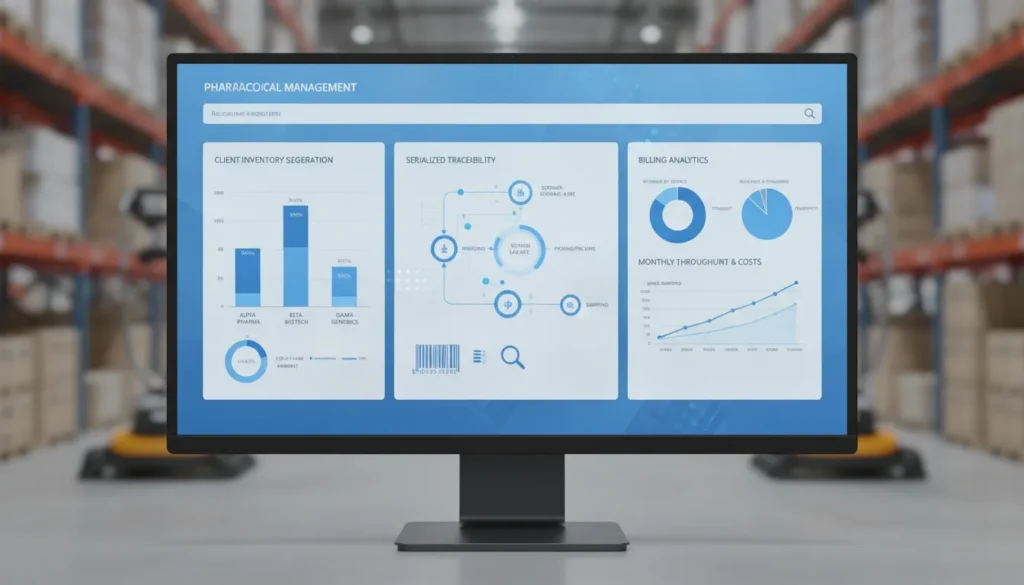
Pharma 3PL software must keep each client’s inventory, serialized records, permissions, transactions, and charges separate while giving operators one controlled view of warehouse activity. It should apply DSCSA controls at transaction level, preserve audit-ready traceability, and prevent one client’s users or data from crossing into another account. Billing must use client-specific rates for storage, handling, orders, and other services, then tie every charge to clear operational records. These controls also support the product tracing duties the FDA identifies for 3PLs and other drug supply chain trading partners. Together, segregation, traceability, and automated billing let a multi-client operation scale without multiplying compliance risk, invoice disputes, or manual reconciliation across the warehouse.
The central question is not whether a platform can track stock, but whether it can clearly protect every client’s data while producing defensible charges. What pharma 3PL software must handle first sets the operating baseline for that control. Here’s how.
What pharma 3PL software must handle first
A pharma 3PL does more than move goods through a warehouse. It stores regulated products, follows each client’s instructions, and protects product data through every handoff. Its software must keep those duties connected without mixing one client’s inventory, records, or access with another’s.
Client inventory boundaries
Client segregation is the first test for any pharma 3PL system. Each owner needs a clear inventory position, even when several owners use the same site, staff, and workflows. The system must preserve ownership as products move between receiving, storage, picking, staging, and shipment.
That separation must also apply to users, documents, and transaction history. A client portal should show only the right client’s stock and activity. Internal teams still need one operating view for warehouse control. This balance is central to pharma 3PL logistics compliance. Physical stock and its digital record must stay aligned.
Traceability within daily work
Pharma logistics adds a compliance layer to ordinary warehouse tasks. The FDA states that DSCSA sets product tracing rules for trading partners, including third-party logistics providers. It also requires wholesale distributors and 3PLs to be licensed and report licensure details each year. These FDA requirements for authorized trading partners make compliance part of routine operations.
Software must connect each product event to the right client, item, location, and record. A receiving error cannot remain only a warehouse exception. It may also affect traceability, client reports, release decisions, and audit support. The system should make that chain visible instead of forcing staff to rebuild it across separate tools.
One operating record
Generic WMS tools often focus on bins, picks, and shipments. Generic ERP tools often focus on orders, invoices, and accounting. A multi-client pharma operation needs both views, plus serialized traceability and strict client boundaries. Problems arise when teams bolt these functions together and rely on manual transfers between them.
Those gaps create duplicate entry, mismatched records, and slow exception handling. They also make it harder to answer basic client questions about stock status or transaction history. Pharma 3PL software should start with one operating record. It must follow inventory from receipt through shipment while preserving ownership, access, and traceability.
Client segregation requirements for pharma 3PL operations
Client segregation is the operating boundary that keeps each owner’s products, records, and actions distinct within a shared pharma 3PL facility. It must apply to inventory, system access, transaction data, and the evidence used during an audit.
Ownership and serialized inventory boundaries
Every receipt should establish the client owner before stock becomes available for movement or order allocation. The system must retain that owner through each transfer, adjustment, pick, pack, shipment, and return. Staff should not be able to assign one client’s stock to another client’s order.
Separation must reach the lot, expiration date, and serialized unit level. Shared locations can work, but the system must keep each client’s available, held, damaged, and recalled stock distinct. A pharma 3PL logistics compliance framework connects these inventory boundaries to traceability workflows.
Physical separation may use dedicated zones, bins, labels, or handling rules based on the product and client agreement. Logical separation must remain active even when two clients use the same storage area. Barcode scans should confirm both owner and item before each warehouse move.
Permissions and client-level visibility
Role-based permissions should control which client records each warehouse worker, manager, and outside user can view or change. A client portal should show only that client’s inventory, orders, transactions, and reports. The 3PL team still needs a full operating view across authorized accounts.
Data isolation also applies to exports, saved searches, dashboards, alerts, and application integrations. Each request should carry a client context before the system returns data or accepts a change. This design lowers the risk of cross-client data contamination through routine work.
- Restrict users by client, role, site, and action.
- Filter every inventory and transaction view by owner.
- Test reports, exports, and integrations for data leakage.
Permission testing should cover common roles and unusual paths, such as bulk exports or temporary staff access. Teams should review access when duties change. They should also remove inactive users without delay.
Audit trails and contamination controls
The FDA explains that DSCSA product tracing requirements apply to trading partners, including third-party logistics providers. Segregated records help a pharma 3PL retrieve the right transaction history without mixing evidence from other clients.
An audit trail should record the user, client, time, prior value, new value, and reason for each key change. Exception rules should stop transfers, allocations, or exports when the client context does not match. Clear logs also help teams trace mistakes and correct affected records.
Good controls prevent contamination before it reaches a shipment or client report. They also make access reviews and audit preparation easier. The wider compliance workflow should preserve the same client boundary from receipt through final disposition.
Billing and invoicing capabilities a 3PL platform needs
Client-level charge capture
A pharma 3PL needs to capture each billable event for the correct client as the work occurs. Those events may include receipts, picks, packs, shipments, returns, relabeling, or other agreed services. The platform should connect each charge to the related order, item, lot, serial record, user, and time stamp.
This link between work and charges matters because client contracts rarely use one simple rate. One client may pay by transaction, while another pays by pallet position, unit, or service task. A client-level charge ledger keeps those rules separate and lowers the risk of missed or misapplied fees.
Client segregation must extend from warehouse records into billing records. Staff should not need to copy activity between systems or filter mixed data by hand. Clear access rules also let each client review its own charges without seeing another client’s rates or activity.
Flexible rate and service models
The billing engine should support transaction fees, recurring storage fees, and custom service models in one controlled workflow. It should also handle minimums, tiers, and contract-specific exceptions without manual spreadsheet work. Each rate card must apply only to the right client, service, facility, and billing period.
- Transaction rules should turn completed warehouse events into charges.
- Storage rules should use the agreed unit, timing method, and client inventory balance.
- Custom service rules should capture labor or handling work that falls outside standard flows.
- Exception controls should route unusual charges for review before invoicing.
Financial automation should start at the operational event, not after month-end. When warehouse activity creates a draft charge, finance teams can review exceptions instead of rebuilding invoices. This approach also makes multi-client operations easier to scale without mixing client data or rate rules.
Traceable invoices and revenue controls
An invoice total is not enough. Each line should show what service occurred, which rule priced it, and what source record proves it. That trace helps the 3PL answer client questions, resolve disputes, and find revenue leakage caused by unbilled work.
Traceability also supports the wider control needs of pharmaceutical logistics. The FDA describes product tracing requirements for drug supply chain trading partners, including 3PLs. Billing records should stay tied to the same controlled events rather than live in a separate, hard-to-audit process.
Teams evaluating a platform should test invoice drill-down with real client contracts and edge cases. They should confirm that users can trace a charge back to its source without exporting several reports. That same discipline strengthens pharma 3PL logistics compliance by keeping financial and serialized operational records connected.
How DSCSA and serialization change 3PL software requirements
Traceability becomes part of each transaction
DSCSA changes traceability from a warehouse reporting task into a core transaction control. The FDA identifies 3PLs among the drug supply chain entities covered by product tracing requirements. A pharma 3PL therefore needs software that connects each physical product movement with the right client, item, lot, and serialized record.
That link must remain intact as teams receive, store, pick, pack, ship, return, or quarantine products. EPCIS event data can record what happened, when it happened, where it occurred, and why. The system should exchange that data without forcing staff to rebuild records in a separate compliance tool.
Client segregation must include serialized data
Physical inventory separation is only one layer of control. A 3PL must also keep each client’s serialized events, transaction history, permissions, and reports apart. Shared or mismatched records can slow an investigation and make a routine client request harder to answer.
Strong pharma 3PL logistics compliance starts with client-level controls inside the same system that runs warehouse work. Each scan should update the correct owner’s inventory and trace record at once. Role-based access should let clients see their own data without exposing another company’s products or activity.
Exceptions, recalls, and audits need usable records
Serialization creates more than a record of successful movement. It also creates exceptions that teams must resolve, such as duplicate serials, missing events, or records that do not match inventory. Software should route those issues to an owner, preserve the action history, and stop affected product from moving when needed.
Recall response also depends on fast, precise searches. Teams should be able to trace affected serialized units, locate current inventory, and show related movements without combining several exports. Clear exception logs and transaction-level evidence help staff answer auditors and client teams with less manual work.
Regulatory status adds another software need. Wholesale drug distributors and 3PLs must be licensed and report licensure information to the FDA each year to act as authorized trading partners. A useful platform keeps compliance evidence organized while supporting client reports on inventory, movements, exceptions, and recall actions.
The result is a different standard for 3PL technology. Basic warehouse software may track quantities and locations, but pharma operations need serialized identity, client segregation, event exchange, and audit-ready history. Those controls must work together during daily tasks, not sit in separate systems that staff reconcile later.
Comparison: generic ERP vs pharma-native 3PL ERP
A generic ERP or WMS can manage common warehouse tasks, but a pharma 3PL has a narrower margin for system gaps. It must separate each client’s stock, transactions, access, and charges while keeping the full warehouse visible to its own team.
Compliance adds another layer. The FDA explains that DSCSA product tracing requirements apply to trading partners, including third-party logistics providers. A sound comparison must test how each platform handles serialized data during routine work, not just whether it offers a compliance add-on.
Core operating differences
| Area. | Generic ERP or WMS. | Pharma-native serialized ERP. |
|---|---|---|
| Client segregation. | Often depends on custom locations, rules, and access roles. | Built around separate client inventory, data, and permissions. |
| DSCSA compliance. | Usually needs an added traceability system or integration. | Connects serialized traceability to each transaction. |
| Billing automation. | May require exports, spreadsheets, or custom billing logic. | Links client service rules to operational activity. |
| Inventory visibility. | Warehouse views may not support safe client-level access. | Supports both operator and client-level inventory views. |
| Reporting. | Reports often need custom fields and joined data. | Uses client, inventory, transaction, and billing data together. |
| Implementation risk. | More integrations and custom rules can create more failure points. | Native workflows can reduce integration and testing scope. |
The main difference is the platform’s data model. Generic software often treats client segregation as a set of configurations layered onto a shared warehouse record. A pharma-native system starts with separate client ownership, access, inventory, and transaction histories as core operating rules.
That design matters when teams receive, move, pick, ship, investigate, and report on serialized products. RxERP’s guide to pharma 3PL logistics compliance explains how serialized ERP supports logistics work under industry rules.
Billing and visibility controls
Billing should follow the same client boundaries as warehouse work. A pharma-native ERP can connect storage, handling, and transaction activity to each client’s service model. This approach reduces the need to rebuild charges from separate exports after the work is complete.
Visibility also needs two views at once. The 3PL needs a full operating view, while each client should see only its own inventory and transactions. Strong role controls and client-level reporting help prevent data contamination without hiding warehouse-wide issues from operators.
Implementation risk
A generic platform is not always the wrong choice, but its fit depends on the amount of custom work required. Teams should map every integration, ownership rule, access role, report, and billing trigger before they select it. They should also test exceptions, not only the standard receiving and shipping path.
A pharma-native platform lowers risk when required controls already share one data model. Buyers can review inventory management capabilities alongside serialization, billing, reporting, and client access. This makes it easier to spot any remaining gaps before implementation begins.
How to evaluate pharma 3PL software before selection
A strong evaluation starts with real client work, not a generic feature checklist. Build test cases from current contracts, warehouse rules, compliance duties, and billing terms. Then ask each vendor to run those cases in a live product demo.
Regulatory fit belongs in the first review. The FDA requires appropriate licensure and annual reporting for wholesale drug distributors and 3PLs acting as authorized trading partners. Software should support that operating context without forcing staff to bridge gaps with spreadsheets.
Evaluation scope and test data
Choose several client profiles that expose different needs. Include a high-volume account, a client with unique storage rules, and one with complex fees. Use masked data where possible, but keep the workflows and exceptions realistic.
-
Map each client workflow. Follow inbound receipt, putaway, inventory moves, allocation, picking, shipping, returns, and recalls. Note every handoff, approval, document, and client-specific rule. The vendor should show how staff complete the full flow and manage an exception.
-
Test client segregation. Create two clients with similar products, locations, and users. Confirm that inventory ownership, transaction history, permissions, documents, and reports stay separate. Also test whether warehouse leaders can manage shared operations without exposing one client’s data to another.
-
Validate serialization and DSCSA flows. Process serialized inbound and outbound transactions, then trace a package through its history. Test suspect product handling, returns, and data exchange failures. Use a detailed pharma 3PL logistics compliance framework to define the expected controls before the demo.
-
Run billing scenarios. Test storage, handling, transaction, project, and exception fees across several clients. Change a rate mid-period and correct a disputed charge. Review the audit trail from an invoice line back to the source activity.
-
Check reports and client access. Ask users from operations, finance, compliance, and client service to run their core reports. Confirm filters, exports, scheduled delivery, access rules, and transaction drill-downs. The results should reconcile with inventory and billing test data.
-
Confirm integrations and ownership. List every required connection, including warehouse devices, trading partners, finance tools, carrier systems, and client portals. For each one, define data direction, timing, error handling, monitoring, and support ownership. Require vendors to explain any custom work and ongoing upkeep.
Proof before scoring
Record pass or fail results against the same script for every vendor. Do not award full credit for roadmap items, slides, or verbal assurances. Ask for proof in the product, along with the setup and staff effort needed.
Score both normal work and failure recovery. A suitable pharma 3PL system should keep client records separate while giving teams one controlled operating view. Reviewing the vendor’s broader solutions for 3PL providers can also reveal whether the product supports specialized operations or only general warehouse tasks.
Selection controls
Before selection, document gaps, workarounds, costs, owners, and target dates. Include setup, data migration, validation, training, support, and change control in the final review. The best fit is the system that proves critical workflows with the least operational risk.
Reporting and client portals matter after go-live
Go-live is the start of the reporting phase, not the end of the software project. A pharma 3PL must turn daily warehouse events into clear, client-level proof of work. That proof should cover inventory, orders, exceptions, fees, and service levels without mixing data between clients.
Dashboards built for client trust
A client portal gives each pharma company a controlled view of its own products and transactions. Clients can check stock, order status, and recent activity without asking the 3PL team for a manual report. The 3PL still needs one operating view across the warehouse, with strict client segregation underneath it.
Useful business intelligence starts with questions that both teams can act on. Which orders missed a cutoff? Which items are nearing an agreed storage threshold? Which exceptions remain open, and who owns the next step? RxERP solutions for 3PL providers connect these client needs with the warehouse work behind them.
- Inventory on hand, available, allocated, quarantined, and held.
- Order volume, status, cycle time, and service-level results.
- Open exceptions, aging items, and unresolved client requests.
- Storage, handling, shipping, and special-service activity.
Exception management and inventory aging
Summary totals can hide the work that needs attention. An exception dashboard should bring holds, short picks, damaged stock, failed validations, and delayed shipments into one queue. Teams can then sort by client, item, age, or risk and act before a small issue grows.
Inventory aging reports add another layer of control. They help the 3PL and client review slow-moving stock, storage exposure, and items that need a clear decision. The report should preserve product and transaction detail because the FDA states that the DSCSA sets product tracing requirements for drug supply chain trading partners.
Aging views work best when users can move from a high-level chart to the affected lot, serial, location, or transaction. That path lets operations staff find the cause while client teams see the business impact. It also makes recurring exception patterns easier to discuss during service reviews.
Charge review and audit-ready exports
Client reporting should show how operating activity becomes a charge before an invoice is issued. A review view can group storage, handling, shipping, and added services by client and billing period. Staff can inspect unusual charges, compare them with source activity, and resolve disputes with a shared record.
Audit exports should follow the same principle. A useful export includes the client, time, event, item, status, and related source record. It gives compliance and finance teams a repeatable way to answer questions without rebuilding evidence from emails and spreadsheets.
For regulated work, reporting must connect service proof with serialized transaction records. A pharma 3PL logistics compliance approach keeps operational, client, and traceability views tied to the same data. After go-live, that shared record helps dashboards prove service levels instead of merely displaying activity.
Frequently Asked Questions
How should pharma 3PL software segregate each client’s inventory and data?
Pharma 3PL software should maintain separate ownership records, permissions, inventory balances, serialized product histories, and reports for every client. Warehouse teams still need one operational view for receiving, storage, picking, and shipping. The system should prevent one client from viewing or changing another client’s records while preserving an auditable history of every transaction.
What billing capabilities should a pharma 3PL system include?
A pharma 3PL system should calculate charges from each client’s contract and actual activity. Common billing inputs include storage, receiving, picks, shipments, special handling, and transaction volume. The system should keep rate cards separate, link charges to supporting records, manage exceptions, and produce invoices that clients can review without relying on manual spreadsheets.
Does a pharma 3PL need DSCSA product tracing for every client?
A pharma 3PL needs controls that support its role and each client’s regulated transactions under the DSCSA. The FDA states that the DSCSA establishes product tracing requirements for drug supply chain trading partners, including 3PLs. Software should therefore preserve client-specific serialized records, transaction histories, permissions, and audit evidence without mixing data between accounts.
How can a pharma 3PL verify that client segregation controls work?
A pharma 3PL can test segregation by using client-specific roles, sample inventory, and controlled transactions before launch. Review whether users can access only authorized products, serial records, invoices, and reports. Teams should also test billing rules, exception handling, data exports, and audit logs. Repeat these checks after configuration changes, new client onboarding, and permission updates.
Ready to tighten client controls and billing?
Waiting to replace fragmented 3PL systems leaves every new client exposed to avoidable segregation gaps, billing disputes, and slower month-end work. Starting now gives your team time to map each client’s inventory, access rules, service rates, and reporting needs before the next onboarding. That early planning creates a clearer path to controlled operations, accurate invoices, and client-ready visibility without another rushed software decision.
Make the next client launch the deadline for better controls, not another reason to accept manual work. Ready to move from requirements to a practical rollout plan today? Schedule a demo of RxERP’s Serialized ERP to review how one pharma-native platform can support segregated client operations and day-to-day billing workflows.