
Online pharma orders expose every gap between a buyer portal and fulfillment. Buyers need fast reordering and account pricing, while distributors must preserve traceability, product control, and transaction data behind every shipment.
Schedule a demo with RxERP to see how pharma-native ERP can connect B2B ordering, serialized inventory, and DSCSA-ready workflows in one operating record.
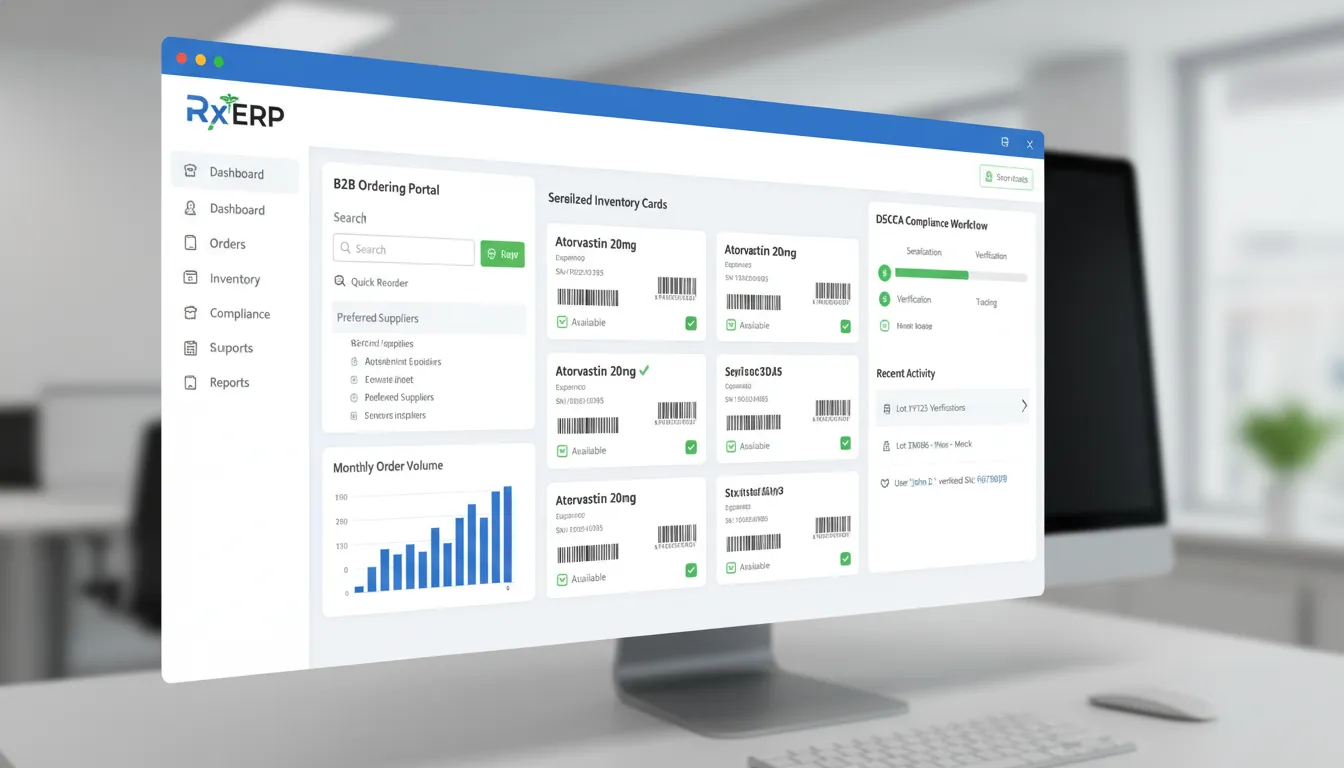
Pharmaceutical ecommerce software gives authorized business buyers a digital portal to browse approved products, place repeat orders, and manage account-specific purchasing. Unlike a general storefront, it must connect each order to pharmaceutical operations, including inventory controls, customer records, fulfillment, and the data needed for traceability. For prescription drug supply chains, this matters because the FDA states that DSCSA product tracing requirements apply to transactions for most finished human prescription drugs. A portal tied to a pharma-native ERP can align the buying experience with serialization, operations, and compliance workflows rather than isolating orders in another system. For wholesalers, 3PLs, manufacturers, and specialty pharmacies, the goal is simple: convenient B2B ordering supported by controlled, traceable execution.
The central question is not whether buyers want online ordering; it is whether the portal can carry the control pharmaceutical distribution requires. To evaluate that fit, start with the basic definition: What is pharmaceutical ecommerce software? The path begins with
What is pharmaceutical ecommerce software?
Pharmaceutical ecommerce software is a business-to-business ordering portal built for regulated drug distribution. It lets approved buyers search products, submit orders, and manage account terms online. Unlike a retail cart, it must keep each order connected to product identity, customer rules, and the system of record.
A portal tied to pharma operations
For a wholesaler, 3PL, manufacturer, or specialty pharmacy, an online order is an operational event. It may affect lot or serial data, inventory status, shipment records, invoicing, and later verification work. The portal needs a live ERP link, not a separate storefront that exports orders after the fact.
Under the DSCSA product tracing requirements, covered transactions for most finished human prescription drugs must provide and capture tracing information. A B2B portal should pass required data through the order flow. Serialized inventory should remain linked to the item shipped.
Integration also keeps service staff from resolving an order with one view while a warehouse works from another. When inventory, serial status, and account terms stay connected, each team acts on the same order record.
More than a generic online cart
Generic ecommerce can display a catalog and accept a purchase order. Pharma buyers also work with account-specific controls that shape what can be ordered and how an invoice is resolved. A useful pharmaceutical ecommerce software platform supports these workflows within one controlled process:
- Serialized inventory visibility by lot, package, or required product identifier.
- Customer-specific catalogs, contract price rules, and chargeback workflows.
- Buyer roles, access controls, approvals, and secure account handling.
- Order data that moves into ERP, finance, and compliance records.
Contracts and chargebacks also make the ordering path account based. A buyer may see approved products, agreed terms, and purchase limits for that account. The seller needs order and price context to reach finance workflows. Records should preserve why a price applied.
Where pharma-native ERP fits
RxERP approaches the portal as part of a pharma-native ERP. Operations, finance, and compliance work from the same business record. That design connects ordering to serialization and traceability instead of treating compliance as a later data task.
Teams assessing a portal can review how B2B ordering portals for serialized inventory link commerce activity with ERP controls. In practice, the right portal is not only a website where a pharmacy or distributor buys product. It is the controlled entry point for order, account, product, and tracing data.
That distinction matters when the buyer expects speed and the seller must preserve reliable distribution records. Pharmaceutical ecommerce software makes ordering easier only when the records behind each order stay complete, secure, and usable.
Why generic B2B portals fall short in pharma
A storefront is not a traceability system
A generic B2B portal can present products, accept orders, and show customer pricing. Pharma orders carry another layer of work. The system must connect each sale with the product, trading partner, and traceability record behind it.
The DSCSA requires trading partners to capture tracing information with transactions for most finished human prescription drugs. The FDA product tracing requirements apply to manufacturers, repackagers, wholesale distributors, and dispensers. A separate portal can leave teams matching orders with tracing data after checkout.
Controls that commerce workflows must carry
Pharmaceutical ecommerce software should treat ordering as an ERP workflow, not a separate web sale. Product eligibility, customer authorization rules, release controls, and exception review need a shared data source. So do lot, serial, and shipment records used in daily fulfillment.
Use this table to check where the portal logic lives.
| Area. | Generic portal. | Pharma ERP portal. |
|---|---|---|
| Traceability. | Order record first. | Order links to tracing records. |
| Lot and serial data. | Later sync. | Data moves with fulfillment. |
The table above shows where a generic portal can create gaps. It also shows why pharma teams need one order workflow tied to ERP records.
These differences affect routine work, not just audit preparation. An EDI order may arrive without a buyer using the portal screen. If online orders and EDI follow separate logic, staff must compare results. They must also fix holds and check fulfillment data in more than one place.
For distributors and 3PLs, the key question is not whether a storefront looks modern. It is whether each order follows the same rules as receiving, allocation, shipping, and compliance review. Read about B2B ordering portals for serialized inventory when assessing this link.
ERP backbone before portal features
A portal shortlist often starts with catalogs, search, account pricing, and repeat ordering. Those functions matter, but they do not settle the core systems question. Buyers should map where eligibility checks, EDI processing, inventory status, lot data, serial data, and tracing documents will live.
That map shows whether the portal is a new channel on a trusted backbone or a data island. Teams that integrate pharmaceutical ecommerce software with ERP processes can judge portal features where orders are controlled and fulfilled.
What features should a pharmaceutical B2B ordering portal include?
A pharmaceutical B2B portal is not a retail cart with extra account fields. It must control who can order, what they may buy, and how each transaction moves into operations. These organizations serve different buying paths. For pharma teams RxERP serves, including distributors, 3PLs, virtual manufacturers, specialty pharmacies, micro-distributors, and government buyers, the portal should connect to the ERP record.
Account, catalog, and pricing controls
Role-based accounts let a buyer, approver, purchasing team, or contract administrator see the work and products tied to that role. A government account may need approval paths. A specialty pharmacy may need a focused catalog and repeat-order controls.
Customer-specific catalogs and contract pricing should show eligible products and agreed terms at login. Buyers can review terms before sending a purchase order. Chargebacks should connect to the contract, order line, invoice, and supporting record. This chain helps teams review exceptions without rebuilding a sale from spreadsheets.
Order status should show back orders, shipment updates, returns, and useful documents in one view. That view helps a small distributor track limited stock. It also helps a larger buyer manage many delivery sites.
Serialized stock and tracing records
Inventory visibility must serve regulated products, not just show a quantity. Buyers and fulfillment teams need lot, expiration, location, and serial detail. Those fields may govern product release or shipment. B2B ordering portals for serialized inventory should keep web orders aligned with warehouse records.
DSCSA belongs in the transaction path. The FDA product tracing guidance explains transaction tracing rules for most finished human prescription drugs. A portal should exchange tracing data and support verification work. It should also retain records linked to ordered products.
Serialized inventory features should preserve the identity of shipped product through fulfillment and return review. Audit trails should record account changes, price overrides, shipment events, and document access. This history supports 3PL workflows. It also helps teams respond to a traceability inquiry.
EDI, ERP, and finance connections
EDI cannot be a side channel that leaves web orders out of sync. The portal should send agreed electronic transactions through the data also used by the ERP. This includes customer, pricing, product, and order data. Finance should receive invoice and payment detail without manual re-entry.
Teams should integrate pharmaceutical ecommerce software with finance and fulfillment records before launch. This link helps contract pricing, chargebacks, stock allocation, invoicing, and order status use one data path.
Use a role-and-workflow review when selecting a portal:
- Map account roles, approvals, catalogs, and contract or chargeback rules for each buyer group.
- Test EDI, ERP, and finance exchanges through a full order, shipment, invoice, and return cycle.
- Verify that serialized items keep tracing data and audit history connected to each transaction.
How does DSCSA compliance affect pharmaceutical ecommerce?
DSCSA compliance affects pharmaceutical ecommerce by requiring online ordering workflows to preserve traceability, authorized partner controls, product identifiers, and transaction records for covered prescription drugs. The portal should keep order activity connected to compliance data before, during, and after fulfillment.
Order controls and trace records
In pharmaceutical ecommerce, an order is more than a digital purchase request. For covered products, the online workflow must connect ordering with product tracing. Trace work should not begin only after a shipment has left the warehouse.
The FDA product tracing guidance describes DSCSA tracing and authorized trading partner requirements. It also identifies product identifier and verification duties for manufacturers, repackagers, wholesale distributors, and dispensers. As a result, portal records should keep orders, receipts, and returns tied to trace data.
An online catalog may let an approved buyer find products and submit an order quickly. It should not separate that experience from serialized records used after submission. When commerce and compliance data remain aligned, staff can review an order without rebuilding its history from separate exports.
Authorized partners and serialized items
Pharmaceutical ecommerce software can place serialized product data within the order flow. Account permissions, ship-to controls, and item status checks can occur before release. This approach connects customer convenience to the traceability needed by B2B ordering portals for serialized inventory.
This matters at the point of release, not only after fulfillment. A customer account can appear valid while a business record or item still needs review. A controlled order path lets a team resolve that issue before creating further downstream work.
Transaction information also needs an operational home. Order, shipment, receipt, and return events should be easy for approved staff to find. A connected workflow can reduce manual searching while keeping the decision and its supporting data together.
Exception handling and review
DSCSA-aware commerce work does not end when an order is submitted. A missing identifier, unmatched trace record, failed partner validation, or disputed receipt can create an exception. The system should pause the affected action, retain the record, and route review to the responsible team.
Useful exceptions are specific. They distinguish a partner review from a serialized item mismatch or missing transaction information. Each queue can carry the order number, product detail, reason for hold, assigned reviewer, and resolution note.
That workflow supports a clear audit trail without claiming that software alone assures compliance. Teams assessing DSCSA compliance software should look for exception queues, role-based review, trace data access, and documented resolution steps. A plain-English DSCSA overview can give staff shared terms for those controls.
Connect the ordering portal to the pharma ERP backbone
One transaction record from order to shipment
Pharmaceutical ecommerce software should not create a second operating system beside the ERP. An online order can affect sellable stock, account terms, purchasing needs, warehouse work, and shipping records. When the portal passes each order into a pharma-native ERP, teams work from one transaction trail instead of matching separate files.
This matters because prescription drug orders carry product tracing duties. The FDA explains DSCSA product tracing requirements for transactions involving most finished human prescription drugs. A portal connected to serialized ERP records can keep the commercial order tied to the product and transaction history needed for review.
That connection starts before a buyer clicks submit. The portal should draw from the ERP record for available inventory, customer terms, product controls, and ship-to details. It should then return the approved order, fulfillment status, and transaction data to the same system of record.
ERP workflows behind each order
A bolted-on storefront may accept an order, yet leave staff to reconcile inventory or finance after the fact. A connected portal can route an order through account review, allocation, pick and ship work, invoicing, and replenishment signals. Purchasing teams can see demand in the same workflow that tracks supply.
Serialized inventory makes this operating model more important. Lot and serialized records must remain linked as product moves through fulfillment. RxERP positions compliance logic inside its pharma-native platform, rather than as an extra layer. Its approach to B2B ordering portals for serialized inventory supports the link between ordering, traceability, and ERP work.
The audit history is also clearer when order events stay with core ERP records. A reviewer can follow customer access, ordered product, released inventory, shipment activity, and related transaction data in one flow. This reduces the need to reconstruct a record from separate commerce, warehouse, and finance systems.
Shared value for distribution and specialty pharmacy teams
For pharmaceutical distributors, a connected portal gives sales, operations, purchasing, and finance a shared order view. Staff can manage account terms and fulfill orders without losing the serialized product context. Digital supply chain tools can help address risks tied to unexpected demand. A peer-reviewed supply chain review also notes risks from scarce specialty drugs.
Specialty pharmacies need a portal that fits strict workflows, not a shopping cart that ends at checkout. A pharma ERP backbone can connect buyer access, product traceability, fulfillment steps, finance records, and audit history. The result is a controlled order process that serves stakeholders while preserving the records that regulated trade depends on.
Schedule a demo with RxERP before comparing portal tools in isolation. A workflow review can show where ordering, DSCSA records, warehouse execution, and finance need one shared backbone.
How do contracts and chargebacks shape online ordering?
Prices tied to account rules
Consumer ecommerce often shows one listed price and accepts payment at checkout. In pharmaceutical distribution, an online order can depend on the buyer, item, account terms, and permitted fulfillment path. That difference should guide the evaluation of pharmaceutical ecommerce software.
A B2B portal should not treat every logged-in account as the same buyer. It should present the products, price basis, and ordering options allowed for that customer. Buyers can review how cloud ERP may integrate pharmaceutical ecommerce software with the records that support those choices.
Ask vendors how the portal handles contract eligibility before an order reaches finance. A buyer may need to know which agreement applies and when an exception needs review. The buyer also needs to know what appears on the invoice. Clear answers reduce price questions after an order is placed.
Chargebacks and controlled exceptions
Chargebacks make a low online price only part of the process. The platform should help teams capture the contract basis for a transaction. It should also route needed review and keep a usable record. Buyers should ask whether a dispute can be traced to the order and approval path.
Returns and purchasing limits belong in the same evaluation. A portal may need to stop an order, require approval, or direct a return through an approved workflow. This is not the same as adding simple shopping cart rules to a retail storefront.
Look for controls that are clear to both operations and finance teams. Ask who can change an exception and what event creates a credit request. Also ask how records move into reconciliation. Teams need a workflow they can review without rebuilding the transaction by hand.
Order records and traceability
Commercial rules do not remove product tracing needs. The FDA states that DSCSA added requirements to capture product tracing information for transactions with most finished human prescription drugs. Online ordering should link the sales decision to the needed traceability record.
That link matters when a product is returned, reviewed, or subject to an order correction. Buyers should test whether the portal keeps the item record, customer rule, approval, and fulfillment action linked. A separate checkout experience can leave teams searching across systems.
Evaluation should include sample orders, not just feature screens. Test an eligible account, a restricted order, a return request, and a price exception. Then confirm that each workflow shows the right information to customer service, warehouse operations, and finance.
A system designed for B2B pharma should let teams review commercial rules beside serialized inventory workflows. RxERP’s discussion of B2B ordering portals for serialized inventory gives buyers a related point of review. The key question is whether online ordering remains controlled from request through recordkeeping.
How to evaluate pharmaceutical ecommerce software
Start with ownership and rules
Evaluation starts before a demo. Name the people who approve products, place orders, manage credit, fulfill orders, and review compliance records. Include wholesalers, 3PL teams, manufacturers, or specialty pharmacy staff when they are part of the workflow.
For US prescription drug transactions, requirements must shape portal design from the start. The FDA states that DSCSA requires trading partners to provide and capture product tracing information for most finished human prescription drugs. Buyers should test how an order connects to traceability records, not accept a feature checklist.
A practical evaluation sequence
Use one test script across vendors, with the same account, item, contract, serialized unit, invoice, and exception. This keeps the review focused on control and evidence. Check how B2B ordering portals for serialized inventory connect sales activity to product history.
-
Map buyer roles and approvals. Define who can browse, order, approve, manage ship-to addresses, view pricing, and handle exceptions for each account type.
-
Define compliance workflows. Walk through licensed customer review, restricted product controls, returns, suspect-product handling, and record access during an audit or investigation.
-
Verify ERP and finance integration. Require sample orders to pass into inventory, fulfillment, invoicing, credit limits, contracts, and reconciliation without duplicate entry.
-
Test DSCSA and serialized inventory handling. Use scenarios for a serialized sale, a return, a shipment exception, and a trace request. Confirm users can follow the item and transaction trail.
-
Validate catalogs and pricing. Test account-specific products, contract price rules, purchase limits, reorder paths, and blocked products using buyer records that reflect real customer types.
-
Review security controls. Inspect roles, sign-in rules, audit logs, data exchange safeguards, and procedures for granting or ending access. Have security and compliance owners record any gaps.
-
Plan implementation. Set owners for data cleanup, integration tests, user acceptance tests, training, launch support, and post-launch issue review before selecting a platform.
Evidence for a sound decision
Results matter more than presentation. Record outputs, owners, pass criteria, defects, and fixes for each test. A useful next step is to examine how teams integrate pharmaceutical ecommerce software with ERP data and downstream workflows.
Do not score a portal on storefront use alone. RxERP can be assessed within the same scorecard: its pharma-native ERP approach should prove how ordering, finance, compliance, and serialization work together. The implementation plan should name data migration, testing, user training, security review, and launch support before a buying decision.
Schedule a demo with RxERP when your scorecard is ready. The demo can focus on the buyer groups, serialized workflows, DSCSA controls, and ERP integrations that matter for your operation.
.
Frequently Asked Questions
What features should a pharmaceutical B2B ordering portal include?
A pharmaceutical B2B ordering portal should connect approved buyer access, account-specific catalogs and pricing, order history, and purchasing workflows to the ERP record. For regulated distribution, it should also carry lot, serial, and traceability data through order processing. RxERP’s pharma-native approach links digital ordering with operations, finance, and compliance instead of treating the portal as a separate storefront.
How does DSCSA compliance affect pharmaceutical ecommerce?
DSCSA affects pharmaceutical ecommerce when an online order involves covered prescription drugs moving between trading partners. The FDA states that section 582 requires product tracing information to be provided and captured with each transaction for most finished human prescription drugs. A portal therefore needs workflows that preserve required transaction and traceability information as orders move into fulfillment and downstream records.
How do pharma distributors manage chargebacks and contracts in online ordering?
Pharma distributors generally need online orders evaluated against buyer eligibility, customer-specific contracts, pricing terms, and downstream financial processing. A portal should pass the accepted price basis, account, product, and order details into the ERP so finance teams can reconcile contract activity and chargeback workflows. This is why an ordering portal should be assessed together with the underlying operations and finance system, not only on its shopping interface.
Ready to improve your B2B ordering portal?
Waiting to improve ordering can compound buyer friction and keep internal teams managing process gaps by hand. Starting now gives you time to align portal priorities with the workflows that support every order. You can move forward with a clearer plan for buyer access, order handling, and operational review.
Do not let another planning cycle pass without defining what your buyers and team need next. A timely conversation can clarify requirements before you commit resources or connect a new portal process to operations. Ready to take the next practical step? Schedule a demo with RxERP to review your B2B ordering needs. Discuss how pharmaceutical ecommerce software can fit your operation.