
Federal drug safety mandates require every pharmaceutical distributor to share precise digital data across the supply chain. This exchange is vital to prove a product is authentic and safe.
At its core, what is epcis data refers to a global GS1 standard for sharing event records that document product movement through the pharmaceutical supply chain. This digital language allows manufacturers and distributors to capture the who, what, where, when, and why of every product event according to GS1 standards. Under the Drug Supply Chain Security Act, these records provide the unit-level tracking required for compliance; they also protect patients from fake drugs and unauthorized medicines. By using standardized XML or JSON files, EPCIS ensures that different computer systems can communicate well; this replaces old records with a secure digital history. This standardized approach creates a transparent supply chain where every trading partner can verify the authenticity of life-saving products before they reach the patient.
Managing these complex records is now a daily requirement for wholesalers and 3PL providers. Understanding the technical details of these files is the first step toward a compliant and efficient operation. We start the journey of supply chain compliance by defining
What Is EPCIS Data?
Electronic Product Code Information Services, or EPCIS, is the global GS1 standard for sharing data about product movement. In the pharma supply chain, this data acts as a digital trail for every item. It allows partners to capture and share event data in a way that all systems can read. By using this standard, firms can keep a clear record of the chain of custody for every drug they handle.
A global standard for supply chains
EPCIS gives a common language to drug makers, wholesalers, and pharmacies. Before this standard, many firms used their own private ways to track goods. This made it hard for different tools to talk to each other. EPCIS solved this by making a set of rules for how to format and share event data.
Today, it is the main way that trading partners meet the need for a shared, electronic record of product history. This standard does more than just list where a product is. It captures the full context of why a product moved and who was in charge of it at that point.
This detail is a key part of EPCIS standards. It helps ensure that everyone in the supply chain has access to the same high-quality data. This clear view is vital for keeping products safe and ensuring they reach patients on time.
The five Ws of product tracking
To make the data easy to use, EPCIS follows a simple five-part framework. This covers the what, when, where, why, and how of every event. By recording these five pieces of data, firms can trace the path of any item at any time. This makes it much easier to spot errors or find where a product might have gone missing.
- What: This finds the specific product. It includes IDs like a Global Trade Item Number and a serial number.
- When: This marks the date and time of the event. It uses a standard format to avoid confusion between zones.
- Where: This shows the site of the event. It often uses a Global Location Number to point to a specific room.
- Why: This gives the business reason for the move. It notes steps like packing, shipping, or receiving.
- How: This describes the technical state of the data. It shows how the data is sent in files like XML or JSON.
Shared event data also supports grouping, known as aggregation. This occurs when single items go into cases, or cases go onto pallets. EPCIS lets systems track these links. This makes it easy to see which items are inside a larger container.
A supplier can scan one pallet and know which serial numbers are inside without opening every box. This saves time and stops manual count errors. It also helps firms find specific lots if a recall happens.
Serialization vs EPCIS data
While people use the terms together, serialization and EPCIS are not the same thing. Serialization is the process of giving each item its own unique name. You can think of it like giving a person an ID card. It makes the item unique from others of the same type. This is the first step in creating a track-and-trace system.
EPCIS is the language used to tell the story of that item. It is the data standard that lets you share that unique ID with your partners. This ensures that every system along the way can read and store the same information.
The FDA states that trading partners must have a digital way to exchange product tracing data. EPCIS is the tool that makes this happen. It turns raw serial numbers into a useful record that keeps the drug supply chain safe.
Why EPCIS Data Matters for DSCSA Compliance
The Drug Supply Chain Security Act (DSCSA) of 2013 completely changed how companies move medicine. This law moved the industry away from paper pedigrees. Before this, companies used simple paper records to show where a drug came from. Now, DSCSA section 582 replaces those old rules with new product tracing requirements. All trading partners must now share data in a clear, digital way.
This shift to digital data is not just a suggestion. It is a strict rule to help stop fake drugs from entering the supply chain. Manufacturers, wholesalers, and pharmacies must all be able to exchange info to prove a drug is real. To make this work, the industry needs a common language. That language is Electronic Product Code Information Services, or EPCIS. Knowing what is epcis data helps you stay ahead of these rules.
Package level tracing
The biggest change under the law is the move to unit-level tracing. In the past, companies might only track a whole case or pallet. Now, the law says you must track every single bottle or vial. This unit-level detail makes it much harder for bad actors to sell stolen or fake products. It also makes recalls much faster and more accurate if a problem occurs.
EPCIS is the best tool to handle this new detail. While serialization gives each bottle a unique ID, EPCIS is how you share that ID with others. It records exactly who touched the product and when they did it. This unit-level traceability is a core part of the law. Without it, you cannot prove that a specific pack is the same one the maker sent out.
Interoperable data exchange
The law says all data sharing must be interoperable. This means different software systems must be able to talk to each other without errors. A maker in one state must be able to send data that a wholesaler in another state can read perfectly. EPCIS makes this possible by setting a global standard for how to format the data. It ensures that everyone uses the same terms and structures.
Under DSCSA, all trading partners must comply with these sharing rules. This includes makers, repackagers, and distributors. If your systems do not use EPCIS, you may find it very hard to work with others in the supply chain. Using a single standard reduces the risk of errors during a data handoff.
Meeting the 2025 deadline
The industry is now in a critical phase. While the first rules started years ago, the full move to electronic tracing has a final date. The FDA has set a deadline for enforcement discretion that ends in November 2025. After this date, the grace period for small errors or paper backups will end. Companies must have their full EPCIS systems ready to go by then.
Waiting until the last minute to set up your EPCIS repository is a big risk. Setting up these systems takes time and testing with your partners. If you cannot share data correctly by the 2025 date, you might not be able to receive or ship products. Staying on top of EPCIS data is the only way to keep your business running and compliant.
What Data Does an EPCIS File Contain?
An EPCIS file acts as a digital logbook for the movement of drug products. It records set events to show a clear record of where a product has been. While serialization gives a product a unique ID, EPCIS is the data format used to share that record across the supply chain. This helps trading partners follow FDA rules for electronic tracing. By using a standard format, other systems can read the same file without errors.
The Four Parts of Supply Chain Events
Every time a worker handles a product case or pallet, the system creates an event. EPCIS data breaks these events down into four main parts. This “who, what, where, when, and why” frame makes it easy for systems to track items. Most files focus on these core details:
- What: The unique ID of the item. This includes the Global Trade Item Number (GTIN) plus the serial number or lot number.
- When: The exact date and time the event happened.
- Where: The real place of the event, like a plant or a warehouse. This often uses a Global Location Number (GLN).
- Why: The business step that took place. Common steps include packing, shipping, or receiving a shipment.
These four parts provide a full view of a product’s life path. By tracking these points, firms can check the safety of the drugs they handle.
Standardizing Data with CBV
To make sure every system knows the data, EPCIS uses a helper standard. This is known as the Core Business Vocabulary (CBV). The CBV gives fixed meanings for the data values used in the file. For example, it defines the set codes for business steps like “commissioning” or “packing.” This prevents mix-ups when other firms share files. A well-managed EPCIS repository stores this data so that it is always ready for a search or an audit.
Modern Data Formats in EPCIS 2.0
The new version of the standard, EPCIS 2.0, makes it more simple for tech teams to work with this data. Older files often used complex XML code. Now, the standard supports JSON and JSON-LD formats. These formats are much lighter and easier for modern web tools to read. EPCIS 2.0 also uses REST APIs to help systems talk to each other in real time. This change helps coders build faster tools for tracking vital products. It also allows firms to add sensor data, like heat and cold logs, directly into the event record.
How EPCIS Data Flows Through the Pharmaceutical Supply Chain
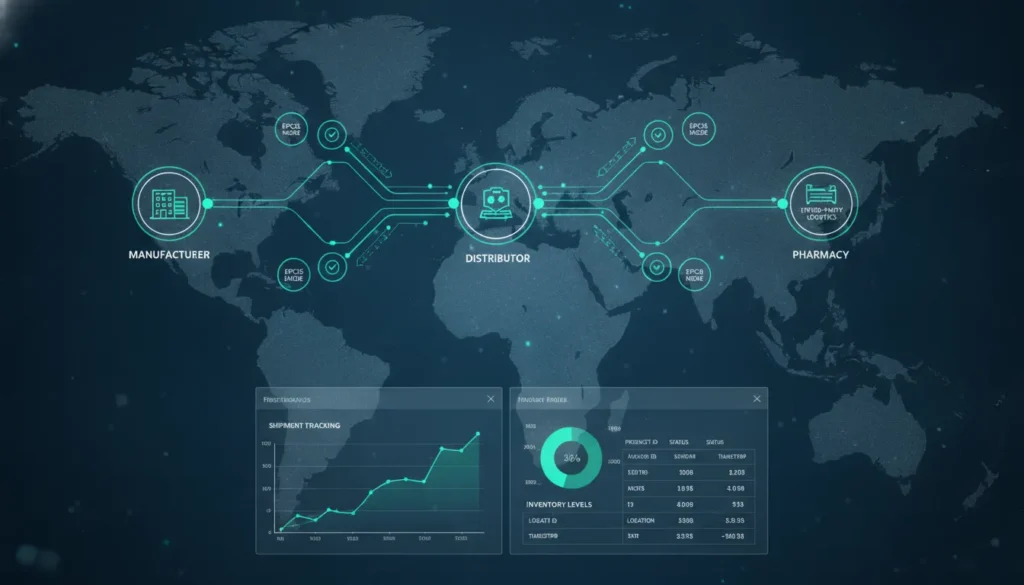
In the past, trading partners used separate systems that did not talk to each other. Now, the industry uses a common language to share data about every product move. This shared way of talking helps systems work together across the whole supply chain. By using this standard, firms can track drugs from the factory all the way to the shelf where a patient gets them.
From making to sending out
The journey starts at the factory. When a maker builds a batch of drugs, they must give each box a unique ID. As these boxes move, the data moves with them. The EPCIS standard lets the maker record the “who, what, where, and when” for every step. This data flow ensures that every partner knows where the goods came from and who owned them last.
- Data Creation: The maker builds an EPCIS file that lists every unique ID on a new pallet. This file serves as a digital map for the physical goods being sent out.
- Aggregation: Workers pack single items into cases and then load those cases onto pallets. This process of aggregation links the unit IDs to the larger container IDs.
- Sending the File: The maker sends the data file to the buyer before the truck arrives. Most firms use an EPCIS data exchange service to move this info safely.
- Scanning at Receipt: When the truck gets to the warehouse, staff scan the pallet ID. The system then looks up the data file to see all the items inside without opening every box.
- Checking the Data: The buyer checks the file against the goods. If the IDs match the data from the maker, the receipt is valid and the items are ready to sell.
Aggregation and item tracking
Aggregation is a key part of how data flows. It lets a warehouse scan one code on a pallet to know what is in every box. This saves a lot of time and cuts down on manual work. Without this link, workers would have to scan every single small box. By linking unit IDs to case IDs, firms can manage product location and counts with high detail. This keeps inventory right and helps find items fast if there is a recall.
Receiving and checking goods
When a wholesaler or 3PL gets a shipment, they must check the data. They use automated EPCIS messaging to speed up this work. This automation removes slow spots in the warehouse and helps teams work better. The FDA requires this electronic track-and-trace to keep the drug supply safe. When every move is logged in a file, it is much harder for fake drugs to enter the market. Good data flow means better safety for every patient.
EPCIS Data Exchange vs. 856 ASN: Key Differences
For years, the pharma supply chain used the 856 Advance Ship Notice (ASN) to share data. This tool tells a receiver what is in a shipment before it arrives. While good for logistics, the ASN only tracks goods at the pallet or container level. It does not give the deep data needed to meet new safety laws.
Unit-level versus lot-level tracking
The main difference between these two systems is the level of detail. An 856 ASN tracks items by lot or batch number. This works for basic tasks but fails to track small units like bottles. EPCIS standards are better because they allow unit-level tracking. Each small unit has its own code. This lets partners see the path of one product as it moves through the supply chain.
Meeting DSCSA requirements
The Drug Supply Chain Security Act (DSCSA) changed the rules for data sharing. Under this law, firms must exchange tracing data in a secure, digital way. Old tools like the 856 ASN do not meet these federal rules. Since EPCIS tracks every unit, it is the only way to stay compliant. Using an EPCIS data exchange service helps your firm follow the law while keeping patients safe.
The 5W framework for supply chain events
EPCIS data uses a “5W” plan to describe every product move. It records what happened, when it took place, and where it went. It also shows why it moved and who was part of the event. A standard ASN cannot hold this much data. By using serialized product data, firms get a full view of a product’s life. This detail makes it easy to find and pull bad products from the market fast.
| Feature. | 856 ASN (Legacy EDI). | EPCIS Data Exchange. |
|---|---|---|
| Tracking Level. | Lot or pallet only. | Unit-level serialization. |
| DSCSA Compliance. | Does not meet 2023 rules. | Needed for full compliance. |
| Data Framework. | Shipment headers and lines. | 5W event data (Who, What, Where, When, Why). |
| Interoperability. | Limited by partner setup. | Global GS1 standard for all partners. |
| Recall Speed. | Slow (needs lot search). | Fast (instant serial lookup). |
How RxERP Simplifies EPCIS Data Management
Managing EPCIS data can be hard for many drug supply chain firms. Most firms use too many tools for shipping, stock, and compliance. This creates data gaps that make it tough to stay compliant. RxERP solves this by offering a unified serialized ERP platform. It combines all your work into one system to keep your data clean and ready for review.
Unified Serialization and Compliance
RxERP is built with a DSCSA-first design. This means compliance is a core part of the system, not just an add-on. Many firms try to link generic ERP tools with other apps to track goods. This often leads to errors or slow data syncs. RxERP unifies these parts to make sure your data stays right. It gives a unique code to each unit and tracks it through every step of your work.
This unity is vital for firms that handle high-volume work. For example, repackagers need strong unit-level tracking during busy tasks. RxERP supports these big jobs while keeping each item visible in the supply chain. By merging tracking and ERP, you lower the risk of losing track of your stock.
Automating EPCIS Exchange
Sharing EPCIS data with partners is a key part of the DSCSA product tracing rules. RxERP automates this exchange to save time and stop manual entry errors. The system acts as a secure digital logbook for every product move. It captures the who, what, where, and when of each event and shares it with your partners in the right way.
The platform handles the complex data files used in EPCIS. You do not need to be a tech expert to manage these data flows. RxERP takes care of the mapping and sending of messages for you. This automation helps you stay fast and lean, even as you add more partners. It ensures your business can keep life-critical products moving without any stops.
Lowering Audit and Operational Risk
Errors in EPCIS data can lead to audit failures or big fines. RxERP helps lower these risks by checking your data in real time. The system looks for gaps in your files before you send or save them. This proactive check helps you catch mistakes early. It gives you a clear and full view of your compliance status at any time.
Being ready for an audit means having easy access to your history. RxERP stores all event data in a secure repository that is easy to search. If agents ask for records, you can pull them up in minutes. This speed and precision protect your firm from the stress of last-minute data hunts. It lets your team focus on moving products instead of fixing data gaps.
Frequently Asked Questions
Is EPCIS data required for over-the-counter drugs?
Based on FDA rules, DSCSA laws do not apply to over-the-counter drugs, animal drugs, or medical gases. Most human drugs in finished form need this data for safe tracking to keep patients out of harm. If you handle OTC items, you may not need to use the EPCIS standard to meet these laws. However, many teams still use it to help with supply chain tracking and find product travel well across their network.
Can EPCIS track temperature for cold chain products?
Yes, the newest version of the EPCIS standard supports sensor data, which allows others to share facts about the status of goods. This is very helpful for cold chain shipments where you can track things like temperature and humidity in real time. Using this data helps ensure that life-saving drugs stay safe and work well during transit. Based on GS1 data, this version also uses a REST API to help systems talk to each other more easily.
What is the difference between serialization and EPCIS data?
Serialization is the act of giving each product unit a unique ID number, but EPCIS is the global standard used to share that data. While serialization marks the product, EPCIS provides a common language for systems to talk to each other across the supply chain. Based on RxERP guides, this gap is key for meeting U.S. laws. You need both to show the full chain of custody for every drug as it moves from one partner to another.
How does EPCIS data help with drug recalls?
Yes, EPCIS data makes tracking products back to their source very simple, which is vital during a recall or quality check. Since each unit has a unique serial number, you can find the exact place of any suspect item in the supply chain. Based on expert views, this helps teams run highly targeted recalls that save time and money. This keeps patients safe and ensures you follow all DSCSA laws without making errors.
Ready to schedule a demo of RxERP’s serialized ERP platform?
Bad EPCIS data can lead to costly delays and audit risks that stop your shipments and hurt your good name in the pharma supply chain. You need a system that keeps your goods moving and helps you avoid the stress that comes from work done by hand in your warehouse. Starting now keeps your supply chain safe while guarding your cash flow from the high cost of non-compliance and lost trade partners in this field.
Ready to schedule a demo of RxERP’s serialized ERP platform? Contact us today to schedule a demo of our unified pharma ERP. Our team will show you how we handle your compliance needs for the long term.