
Table of Contents
- Why Pharma Wholesalers Face Critical Security Pressures Today
- The Hidden Risks of On-Premise ERP Systems
- How Cloud-Hosted ERP Delivers Superior Security Architecture
- Regulatory Compliance and Data Protection in Cloud Environments
- Automated Threat Detection and Real-Time Monitoring Capabilities
- Disaster Recovery and Business Continuity for Pharmaceutical Operations
- Reducing Security Infrastructure Costs Without Compromising Protection
- Our Cloud Platform: Enterprise-Grade Security for Wholesale Distributors
- Implementation Strategy for Secure ERP Migration
- Measuring Security ROI in Your Pharmaceutical Business
- Frequently Asked Questions (FAQ)
Why Pharma Wholesalers Face Critical Security Pressures Today
Pharmaceutical wholesalers operate in an environment where security failures carry immediate, measurable consequences. A data breach doesn’t just disrupt operations; it threatens patient safety, violates regulatory mandates, and erodes customer trust. The stakes are fundamentally different from other industries because you’re handling sensitive information about drug movement, patient data tied to prescriptions, and financial records that directly impact your competitive position.
The threat landscape has intensified. Ransomware attacks on healthcare organizations increased 300% between 2020 and 2023, with pharmaceutical supply chain operators becoming priority targets. Attackers recognize that wholesalers sit at a critical node: connected to manufacturers upstream and healthcare providers downstream, making you a valuable target for supply chain compromise. Simultaneously, regulatory frameworks like the Drug Supply Chain Security Act (DSCSA) now require pharmaceutical wholesalers to maintain serialized product data with strict access controls, audit trails, and rapid reporting capabilities.
Your internal team likely juggles multiple security concerns: legacy system vulnerabilities, staff training gaps, infrastructure maintenance costs, and compliance documentation. Many wholesalers still rely on on-premise systems designed before modern threat actors existed, creating gaps between what regulations demand and what aging infrastructure can deliver.
What to do next: Assess your current ERP’s security capabilities against your DSCSA requirements, particularly around data encryption, access controls, and audit logging.
The Hidden Risks of On-Premise ERP Systems
On-premise ERP systems create a false sense of control. Because you own the hardware and software licenses, it feels like security is in your hands. In reality, on-premise infrastructure introduces distinct vulnerabilities that modern cloud architecture was designed to eliminate.
Physical infrastructure requires constant vigilance. Your servers need climate control, backup power, fire suppression, and physical access restrictions. One overlooked security patch on an aging system, one stolen credential from an employee, or one misconfigured firewall rule can expose your entire operation. You’re responsible for every layer of the stack: from applying OS security updates to managing database encryption keys to ensuring network segmentation works correctly.
Staff expertise compounds the problem. Maintaining enterprise-grade security on premise requires dedicated IT personnel who understand database hardening, network architecture, intrusion detection, and regulatory compliance. Many mid-sized pharmaceutical wholesalers lack this depth of expertise in-house, either underfunding the security team or relying on overextended staff managing multiple operational systems simultaneously. When that key person leaves, institutional knowledge walks out the door.
Scalability of security becomes expensive quickly. Adding users, processing more transactions, or expanding to new warehouse locations means expanding your infrastructure footprint. Each expansion multiplies your attack surface and requires re-evaluating network architecture, access control policies, and disaster recovery capacity. Budget constraints often force delayed security upgrades, leaving systems exposed longer than acceptable.
Disaster recovery on premise is costly and rarely tested at scale. Backup systems sitting in the same facility as your primary systems offer minimal protection against physical disasters. Building truly redundant infrastructure requires multiple geographically distributed data centers, replication technology, and failover orchestration. Most on-premise deployments use tape backups or local redundancy, which recover data but not in the timeframe modern pharmaceutical operations require.
Actionable insight: Request your IT team document their current disaster recovery plan, specifically the objective recovery time (RTO) and recovery point objective (RPO). Compare these targets against your business continuity requirements.
How Cloud-Hosted ERP Delivers Superior Security Architecture
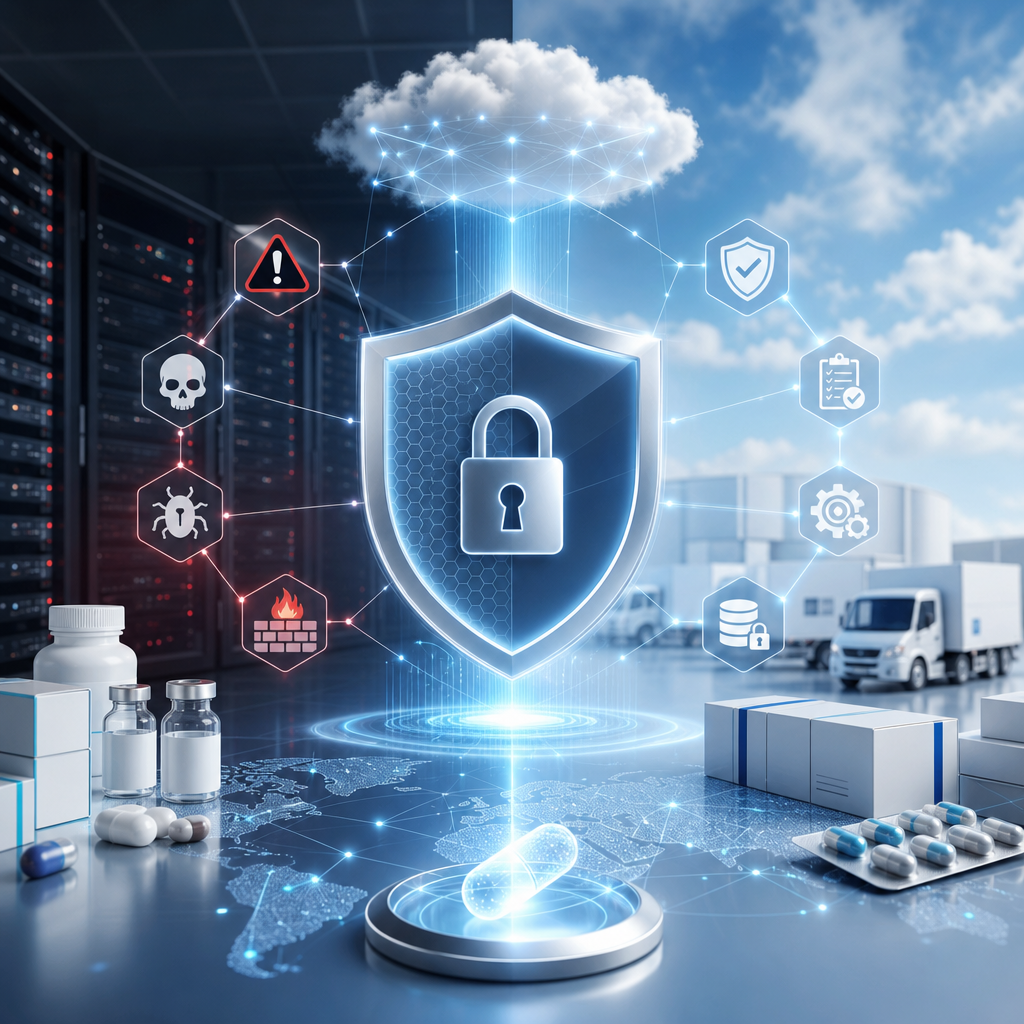
Cloud-hosted ERP platforms are engineered from the ground up for security at scale. Rather than bolting security onto aging infrastructure, modern cloud architecture embeds multiple defensive layers into every component of the system.
First, cloud providers invest in security infrastructure that individual companies cannot match economically. Our cloud platform benefits from shared infrastructure managed by security teams whose entire focus is threat prevention, detection, and response. We maintain encryption at rest and in transit using current cryptographic standards, deploy hardware security modules for key management, and operate with redundant security monitoring 24/7.
Network isolation and segmentation work differently in cloud environments. Your pharmaceutical data doesn’t exist on a single server accessible from a single network. Instead, cloud architecture distributes your data across redundant systems with multiple layers of network isolation. Access to any sensitive data requires traversing multiple security checkpoints: authentication, authorization, encryption key verification, and audit logging.
Multi-tenancy security is a key differentiator. Because cloud platforms serve multiple customers simultaneously, the infrastructure must enforce strict data isolation. This means every architecture decision prioritizes preventing one customer’s data from being accessed by another customer or by unauthorized users. This same architecture protects your data from unauthorized internal access.

Compliance automation is built into the platform. Cloud-hosted systems can enforce DSCSA requirements directly in the application layer rather than relying on periodic audits of external controls. Role-based access control (RBAC) can be granularly defined so that employees only access the specific data required for their role. Audit trails are comprehensive and tamper-evident because they’re maintained by the cloud infrastructure itself, not by staff who might accidentally or deliberately delete records.
Next step: Evaluate whether your current system can demonstrate audit logs older than 12 months and whether those logs are protected from modification.
Regulatory Compliance and Data Protection in Cloud Environments
Pharmaceutical wholesalers operate under multiple overlapping regulatory frameworks. DSCSA requirements around product serialization data, protected health information (PHI) rules under HIPAA, FDA GMPs, and state pharmacy licensing all demand specific data handling practices. Cloud-hosted systems simplify compliance because regulatory requirements are encoded into the platform itself.
When DSCSA requires that you maintain serialized product data with specific metadata and prevent unauthorized modifications, a cloud ERP platform can enforce these requirements automatically. Role-based access controls ensure that only authorized personnel can verify products, view lot-level data, or generate required reports. The system creates immutable audit trails showing exactly who accessed what data and when, removing the burden of manual compliance documentation.
Data residency and sovereignty concerns are addressed transparently. Our cloud platform maintains data within specific geographic regions based on your operational needs, and we ensure compliance with regulations governing where pharmaceutical data can be stored and processed. Data encryption keys are managed with the same rigor as physical vault keys.
Backup and retention policies enforce regulatory requirements without manual intervention. DSCSA requires that you maintain product data for extended periods, and cloud platforms automatically enforce retention policies so that data cannot be accidentally deleted. Multiple copies are maintained across geographically distributed systems, so data loss from infrastructure failure becomes virtually impossible.
Immediate action: Determine whether your current system can prove that you meet DSCSA data retention requirements and whether your backup strategy complies with those requirements.
Automated Threat Detection and Real-Time Monitoring Capabilities
Modern pharmaceutical supply chains move products too quickly for manual security monitoring to catch emerging threats. Automated threat detection and real-time monitoring have become operational necessities rather than optional features.
Cloud-hosted ERP platforms implement continuous monitoring at multiple layers simultaneously. Network traffic is analyzed for suspicious patterns. Database access is monitored for unusual query patterns or attempts to access restricted data. User behavior is analyzed for anomalies: unexpected login times, access from unusual geographic locations, or repeated failed authentication attempts. These systems use machine learning to establish baseline behavior for your users and alert security teams when activities deviate significantly from that baseline.
Threat response is accelerated because cloud infrastructure includes automated response capabilities. Suspicious login attempts trigger immediate multi-factor authentication requirements. Unusual database access patterns can trigger temporary access restrictions, blocking the questionable query and alerting your team before potential damage occurs. This happens in milliseconds, faster than any manual review process could respond.
Integration with threat intelligence feeds means your system automatically knows about emerging attack patterns and vulnerabilities. When new vulnerabilities are discovered in software components your ERP relies on, patches are deployed automatically to your environment without requiring your team to schedule downtime or manage patching manually.
Audit trails created by these systems provide forensic capability. When a threat is detected, the comprehensive audit logs allow your security team to understand exactly what happened, when it happened, and what data was affected. This capability transforms threat response from damage control into informed incident analysis.
What to do: Ask your current ERP vendor whether they provide real-time alerts for suspicious access patterns and whether they automatically apply security patches without requiring downtime.
Disaster Recovery and Business Continuity for Pharmaceutical Operations
Pharmaceutical wholesalers cannot afford extended outages. When your system is down, products cannot move through your distribution network, healthcare providers experience supply disruptions, and patient care is ultimately affected. Business continuity isn’t a compliance checkbox; it’s an operational necessity.
Cloud-hosted systems achieve recovery time objectives (RTOs) measured in minutes rather than hours or days. Because data is replicated across multiple geographically distributed data centers, a complete failure of one facility doesn’t impact your operation. The system automatically redirects traffic to healthy infrastructure, and your users experience minimal disruption.
Recovery point objectives (RPOs) approach zero data loss. Continuous replication means that data written to the system is immediately replicated to backup infrastructure. If a failure occurs, you recover not just the system but your data as it existed at the moment the failure happened. There’s no “restore from last night’s backup with today’s transactions lost” scenario.
Failover is transparent to your operations team. Rather than executing a disaster recovery plan when failure occurs, the cloud platform monitors system health constantly and automatically initiates failover when necessary. Your users might experience momentary latency, but the system remains available. This contrasts sharply with on-premise disaster recovery, which typically requires manual intervention and takes hours to complete.

Testing disaster recovery procedures is simplified in cloud environments. Rather than coordinating complex failover drills that disrupt operations, cloud platforms allow you to test recovery procedures against snapshot copies of your production environment. You gain confidence that your disaster recovery plan works without putting your live system at risk.
Action item: Request your current vendor’s documented RTO and RPO. Verify these targets match your operational requirements for critical systems like order processing and product verification.
Reducing Security Infrastructure Costs Without Compromising Protection
One of the most compelling business cases for cloud-hosted ERP is the dramatic reduction in security infrastructure costs. On-premise security spending typically includes hardware, software licensing, staff expertise, and ongoing maintenance. These costs grow with scale and become particularly burdensome for mid-sized wholesalers lacking IT economies of scale.
Cloud platforms amortize security infrastructure costs across many customers, making enterprise-grade security accessible at a fraction of on-premise costs. You’re not paying for hardware redundancy, physical facility security, power and cooling infrastructure, or dedicated security staff. Instead, you subscribe to a platform that includes these capabilities.
Staff reallocation is significant. Rather than dedicating IT personnel to managing security infrastructure, your team focuses on business-critical systems and operational efficiency. The time previously spent on patching systems, managing backups, and implementing security controls is redirected toward strategic initiatives that improve pharmaceutical operations.
Capital expenditure reduction frees resources for operational investments. On-premise ERP requires periodic hardware replacement, often on a 3-5 year cycle, creating lumpy capital expenses. Cloud platforms operate on predictable subscription pricing with no surprise infrastructure replacement costs. This improves financial planning and allows you to invest capital into growth initiatives rather than infrastructure maintenance.
Compliance audit costs decrease because cloud platforms maintain compliance documentation automatically. Rather than assembling evidence of security controls during annual audits, cloud systems generate compliance reports directly. Audit timelines compress, and audit fees decline when your vendor can demonstrate compliance through automated reporting rather than manual evidence gathering.
Next step: Calculate your current annual IT spending for security infrastructure, staffing, and compliance. Compare that against cloud ERP pricing to quantify your true cost of ownership.
Our Cloud Platform: Enterprise-Grade Security for Wholesale Distributors
We designed our cloud-hosted ERP specifically for pharmaceutical wholesalers operating under DSCSA and other regulatory requirements. Our platform combines serialized product tracking with comprehensive security architecture, so compliance requirements and data protection work in tandem rather than as competing priorities.
Our cloud infrastructure maintains multiple layers of encryption. Data is encrypted at rest using AES-256, encrypted in transit using TLS 1.3, and all encryption keys are managed by hardware security modules that prevent unauthorized access. Role-based access control is granular: you define exactly which users access which products, locations, and transaction types. Audit logging is comprehensive and immutable, creating a complete forensic record of every interaction with sensitive data.
We automate DSCSA serialization requirements directly into our platform. Product verification, lot-level traceability, and suspect product workflows are built into the application layer. You’re not bolting compliance onto generic ERP features; you’re using a platform where pharmaceutical supply chain security is the foundational design principle.
Our business intelligence and analytics capabilities leverage the rich data your operations generate, providing insights that improve efficiency while maintaining strict data protection. Real-time dashboards show you product movement, inventory positions, and compliance status without compromising data security. Our AI-powered reporting identifies optimization opportunities and operational bottlenecks automatically.
Financial automation within our platform includes receivable management, cost tracking, and revenue optimization tools designed for pharmaceutical wholesale margins. Inventory management tracks both physical stock and financial positions simultaneously, so your operations and accounting teams work from the same data.
Immediate consideration: Evaluate whether your current ERP can provide DSCSA-compliant audit trails automatically or whether compliance documentation requires manual assembly.
Implementation Strategy for Secure ERP Migration
Migrating from on-premise to cloud-hosted ERP requires careful planning to minimize operational disruption and ensure that security posture improves during the transition. The migration itself presents a critical security window where old and new systems operate in parallel.
Begin with a comprehensive data inventory. Before migration, understand exactly what data exists in your current system, where it’s stored, and which data requires specific protection under DSCSA and other regulations. This inventory informs your migration sequence: you’ll move regulatory-critical data on a defined timeline when you can thoroughly validate accuracy and security controls.
Parallel operation during transition is essential for pharmaceutical wholesalers. Your old system continues processing orders and transactions while your new cloud system is populated with historical data and tested. Only when you’re confident that the cloud system processes transactions correctly do you switch your operations team to the new platform. This approach minimizes risk because you maintain operational continuity while validating that the new system meets your requirements.
Data validation is particularly critical for serialization data. DSCSA requires that you maintain complete, accurate product data. During migration, every product record must be validated to ensure accuracy. We use automated validation tools to compare old and new system data, flag discrepancies, and allow your team to resolve data quality issues before the migration is complete.
Security controls are strengthened during migration, not compromised. Rather than migrating with the same access controls your on-premise system used, migration is an opportunity to redesign access policies. You define which employees access which data based on their current role. Legacy access patterns that accumulated over years get cleaned up during this transition.
Training and change management are essential for security success. Your team needs to understand new security features, particularly DSCSA compliance workflows, role-based access controls, and how to use new security tools. We provide comprehensive training so your team feels confident using security features rather than viewing them as obstacles.
Key milestone: Before going live with your cloud system, conduct a security validation where your team verifies that access controls work as expected and audit logging captures required compliance data.
Measuring Security ROI in Your Pharmaceutical Business
Security investments should generate measurable business value. For pharmaceutical wholesalers, security ROI appears through reduced operational risk, improved compliance efficiency, and freed internal resources.
Risk reduction is quantifiable. Calculate the probability and financial impact of security breaches in your current environment versus your cloud platform. On-premise breach probability decreases dramatically with cloud infrastructure because automated threat detection and prevention controls catch attacks before they impact your data. The financial impact of a breach (compliance fines, customer notification costs, regulatory remediation) is substantially reduced when your infrastructure limits breach scope and allows rapid containment.
Compliance efficiency improvements reduce audit burden. On-premise compliance audits require manual evidence gathering and can take weeks to complete. Cloud-hosted systems generate automated compliance reports, compressing audit timelines from weeks to days. Measure the time your team currently spends on compliance documentation and reporting, and compare it against cloud platform reports that are generated automatically.
Staff reallocation creates value through operational improvements. Calculate how much time your IT team currently spends on security infrastructure, patching, and backup management. Cloud platforms eliminate these tasks. Reallocating that time toward supply chain optimization, customer service improvements, or financial analysis generates immediate business value.
Avoided infrastructure replacement costs are substantial over multi-year periods. On-premise systems require hardware replacement every 3-5 years, creating capital expenditure spikes. Cloud platforms operate on predictable subscription pricing with no surprise replacement costs. Over a 5-year analysis period, the capital savings often exceed 40% of your cloud platform costs.
Downtime costs provide another measurement. Calculate the cost of each hour of system unavailability: lost transactions, manual workarounds, customer service impact, and operational disruption. Cloud platforms with RTO measured in minutes rather than hours dramatically reduce downtime costs. Even preventing a single major outage often justifies the cloud migration cost entirely.
Immediate action: Document a conservative estimate of your current cost of ownership including IT staffing, hardware replacement, compliance audit burden, and potential downtime impact. Compare this against cloud platform pricing to quantify your expected ROI from migration.
Pharmaceutical wholesalers operate in an industry where security failures carry patient safety implications and regulatory consequences. Cloud-hosted ERP platforms deliver security capabilities that on-premise systems simply cannot match at comparable cost. Our platform is built specifically for pharmaceutical supply chain requirements, combining DSCSA compliance automation with enterprise-grade security architecture. If you’re evaluating ERP solutions or considering migration from legacy systems, cloud-hosted architecture should be your foundation for both operational efficiency and regulatory confidence.
Frequently Asked Questions (FAQ)
How does our cloud-hosted ERP protect our sensitive pharmaceutical supply chain data compared to on-premise systems?
We maintain enterprise-grade security architecture with automated threat detection, continuous monitoring, and multi-layered encryption protocols across all data transmission and storage. Our cloud infrastructure includes redundant security systems, real-time threat response, and compliance automation for DSCSA regulations that would require significant capital investment and ongoing maintenance costs if deployed on-premise. We handle the infrastructure security burden so your team can focus on core pharmaceutical operations while maintaining the highest data protection standards.
What happens to our operations if there’s a security incident or system failure?
We’ve built disaster recovery and business continuity capabilities directly into our cloud platform with automated failover systems and data replication across secure locations. Your pharmaceutical operations continue functioning with minimal disruption because our infrastructure ensures rapid recovery without the downtime risks associated with on-premise systems dependent on single physical locations. We provide transparent monitoring so you can track system health and recovery metrics in real time.
Does moving to a cloud ERP solution actually reduce our security costs without compromising compliance?
Yes, we eliminate the need for your organization to maintain expensive on-premise security infrastructure, dedicated IT staff for system maintenance, and costly hardware replacements while delivering superior security outcomes. Our subscription model includes built-in DSCSA compliance automation, threat detection, and security updates so you avoid the hidden expenses of managing legacy systems. We’ve designed our pricing to deliver measurable security ROI by reducing operational overhead while strengthening your regulatory posture.