
The 12-Digit NDC Is Coming. Can Your Systems Find the Same Product?
By Melody Anderson, Head of Revenue Marketing, RxERP
For operations, IT, and compliance leaders at manufacturers, distributors, 3PLs, and pharmacies who manage item master data, receiving, EDI, or DSCSA records.
Key takeaways
- The FDA’s 12-digit NDC takes effect March 7, 2033. Systems need to handle existing 10-digit NDCs and their 12-digit equivalents during the labeling transition through March 6, 2036.
- Conversion depends on the original NDC segments. Leading zeros belong in the labeler, product, or package segment as needed to reach 6-4-2.
- A 12-digit NDC cannot be embedded in the existing NDC-based GTIN structure. Review software that extracts an NDC from a GTIN.
- GS1 application identifier 715 can carry the NDC as a separate barcode data element alongside the GTIN.
- Start with one product and follow it from receiving through inventory, an outbound order, and traceability records. Use the checklist to turn gaps into assigned actions.
A shipment arrives with the product you ordered, but the receiving system cannot find it. The label carries one version of the NDC; the item master stores another. Someone looks up the item manually or creates a second record to finish receiving. One product now has two records, and inventory, pricing, or lot history can end up split between them.
The FDA’s 12-digit National Drug Code transition puts those connections under greater pressure. It also changes the relationship between the NDC and the Global Trade Item Number, or GTIN, used in serialized workflows. Teams can start now by identifying where codes live, checking how the same product is matched across systems, and finding which changes depend on software vendors or trading partners.
What Is Changing and When
| Date | What happens |
| March 5, 2026 | Final rule published. The FDA continues assigning 10-digit NDCs through March 6, 2033. |
| March 7, 2033 | Rule takes effect. The FDA begins assigning 12-digit NDCs, converts existing 10-digit codes, and updates drug listing files. |
| March 7, 2033 through March 6, 2036 | Labeling transition. Companies begin using updated labels and work through existing labeling stock. Systems must accommodate both formats. |
| March 7, 2036 onward | The labeling transition has ended. Enforcement treatment depends on when a product entered interstate commerce, as explained below. |
The FDA’s new format contains a six-digit labeler code, four-digit product code, and two-digit package code, written as 6-4-2. The FDA will update listing files for the format change. Registrants are expected to update their listings when labeling changes.
Under the FDA’s final rule, unexpired stock with 10-digit NDC labels may remain on the market if the product was introduced or delivered for introduction into interstate commerce before March 7, 2033. Products introduced during the transition with those labels may face enforcement if they are still on the market after March 6, 2036. Final rule, Responses 31 and 44
The FDA rule itself leaves HIPAA billing standards unchanged. However, the FDA expects a replacement standard that accommodates 12-digit NDCs by 2033. Include historical 11-digit billing records in your planning and monitor the separate billing transition.
How 10-Digit NDCs Convert to 12 Digits
Today’s 10-digit NDCs use three segment configurations. Conversion adds leading zeros to the segments that are shorter than 6-4-2. The table also shows the current 5-4-2 billing representation for reference.
| Original format | 10-digit NDC | Current 11-digit billing format | 12-digit equivalent |
| 4-4-2 | 1234-5678-90 | 01234-5678-90 | 001234-5678-90 |
| 5-3-2 | 12345-678-90 | 12345-0678-90 | 012345-0678-90 |
| 5-4-1 | 12345-6789-0 | 12345-6789-00 | 012345-6789-00 |
Illustrative examples only. These show conversion of existing codes. Newly assigned 12-digit NDCs may have no earlier 10-digit equivalent.
- Preserve the segment structure. Adding two zeros to the front of every original 10-digit string works only for the 4-4-2 configuration. The other configurations need zeros in different segments.
- Keep codes as text. Preserve leading zeros in spreadsheets, imports, and integrations.
- Retain a reliable reference for unhyphenated codes. A 10-digit string alone can be ambiguous. Use verified product data or the original segment configuration to convert it.
Why Adding Two Digits Changes GTIN Mapping
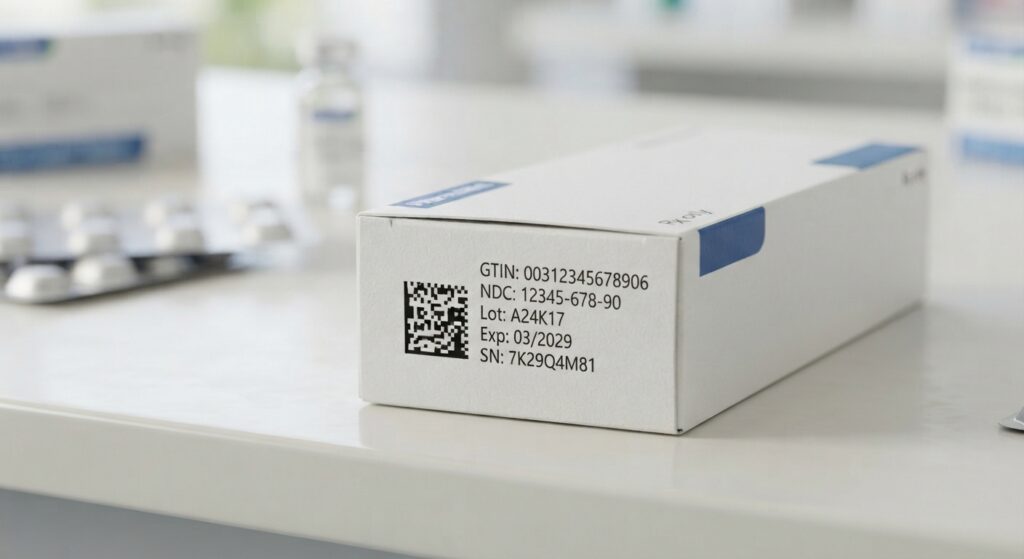
In the established U.S. NDC-based approach, an individual saleable unit’s GTIN-12 contains the digit 3, the 10-digit NDC, and a check digit. When encoded in a GS1 DataMatrix barcode, that GTIN-12 is represented with two leading zeros, making a 14-digit field. A GTIN-14 can identify a higher packaging level, such as a homogeneous case.
Replacing the embedded 10-digit NDC with 12 digits would exceed the available field, as the FDA acknowledged in its response to comments in the final rule. Any system that obtains the NDC by removing digits from the GTIN needs a way to identify the 12-digit NDC and maintain its association with the right product and package record.
GS1 application identifier 715, written as AI (715), identifies the U.S. NDC as a separate data element. A barcode can carry the GTIN and NDC together, along with serial number, lot, and expiration date. The FDA’s NDC format guidance states that a single qualifying 2D DataMatrix barcode may meet both NDC barcode and DSCSA product identifier requirements beginning March 7, 2033.
Test the full path from the barcode to the product record. A successful scan only shows that the scanner captured data. The receiving application must interpret AI (715), preserve the NDC, and match it to the correct product and package. Check what the software actually saves and what the next system receives.
Where NDC Mismatches Can Show Up
- At receiving. A case labeled with a 10-digit NDC may fail to match a converted code in the ERP. Creating another item to finish the receipt can introduce a duplicate.
- In the item master. Duplicate records can split inventory, lot history, and pricing across items. Matching must also preserve differences in strength, dosage form, package size, and packaging level.
- In EDI and file imports. A spreadsheet or integration that treats an NDC as a number can drop leading zeros. That can prevent an order or ship notice from matching the intended item.
- In chargebacks and reporting. Claims, contract pricing, and rebates depend on consistent product identification across partners. A mismatch can delay reconciliation.
- In serialized workflows. When GTINs and product records do not align, teams may need manual reconciliation between traceability data, orders, and inventory.
What to Do Now by Role
Manufacturers and repackagers
- Plan how GTINs and 12-digit NDCs will be associated and how you will share those records with trading partners.
- Review label templates, packaging software, printers, and barcode verification for AI (715).
- Plan labeling changes by product, including when stock enters commerce and its expiration date.
Distributors and 3PLs
- Maintain GTINs and NDCs as distinct identifiers associated with the correct product and packaging level.
- Test scanners and application processing with AI (715) and existing barcodes.
- Ask suppliers for current GTIN and NDC data and their plans for sharing updated identifiers.
- Test incoming and outgoing EDI transactions and file imports for leading zeros, field lengths, identifier types, and matching. Make sure a 12-digit NDC is not classified as a UPC simply because of its length.
Pharmacies
- Coordinate transition plans with your pharmacy system, wholesaler, and billing partners, including changes to transaction standards.
- Plan for receiving older and updated labels and retrieving historical billing records.
Start With One Product and Follow It Through
- Choose a product you receive regularly. Record its strength, dosage form, package size, unit of measure, supplier NDC, and GTIN so you know what a correct match looks like.
- Find every place that product’s identifiers appear, including receiving, the item master, EDI maps, reports, and spreadsheets. Note who owns each system and where one identifier is derived from another.
- Test the original, historical billing, and converted NDC against the same product and package record. Then expand the test set to all three 10-digit configurations and a fictional new 12-digit code with a nonzero first digit, using a test environment.
- Follow the product from a scan or import through receiving, inventory, an outbound order, and the relevant traceability integration. Record the identifiers and product record used at each step.
- Submit an unknown or ambiguous identifier in testing. Confirm the system presents a clear exception for review rather than silently matching the wrong item.
- Turn each failed or unverified check into an action with an owner, target date, and evidence needed to close it. If you find duplicates, preserve inventory and transaction history when resolving them.
Questions to Ask Your Software Vendors
- How does the system associate GTINs, NDCs, and package records?
- Can it retrieve a legacy product using its original, historical billing, and converted identifiers?
- Can it process newly assigned 12-digit NDCs, including six-digit labeler codes with a nonzero first digit?
- Does it interpret AI (715) in the receiving application?
- What is available today, what requires configuration or an update, and how will we test it with trading partners?
Keeping One Product Record Across NDC Formats
During the transition, the same product will show up under several NDC formats: 10-digit codes on existing labels, 11-digit codes in billing, and 12-digit codes from the FDA. If systems treat each format as a separate item, inventory splits, reorder points drift, and reconciliation gets harder. The safer approach is to tie every format to a single product record.
RxERP’s platform is built this way. It links 10-, 11-, and 12-digit NDCs to one product record, and serialization runs inside the same ERP that manages inventory and orders, so product data, serialized data, and transactions stay in one place. Product setup draws on FDA and GS1 data to reduce manual entry.
A clean product record is only part of readiness. Barcode scanning, integrations, and trading-partner exchanges all need testing against the new format. A useful exercise: take one product, its NDC, and its supplier GTIN, and trace it through receiving and inventory. Wherever the identifiers stop matching is where the work is.
Frequently Asked Questions
When does the 12-digit NDC take effect?
March 7, 2033. The FDA will convert existing 10-digit NDCs and begin assigning new 12-digit codes. The labeling transition runs through March 6, 2036, with the inventory provisions explained above.
How will the NDC and GTIN be connected?
The 12-digit NDC requires a separate association with the GTIN and the correct product and package record. AI (715) provides a way to carry the NDC alongside the GTIN in a barcode.
What happens to 11-digit billing records?
Plan to preserve access to historical records and follow your billing partners’ transition guidance. The FDA rule does not set the HIPAA implementation schedule.
Get the 12-Digit NDC Readiness Checklist. Use it to identify what is ready, what needs work, and what still needs an answer. Enter your work email to get your copy.
Once you’ve completed the checklist, book a 30-minute demo to talk through the gaps you’ve identified and how RxERP’s platform can help.