
Table of Contents
- The Compliance Challenge Facing Modern Pharmaceutical Operators
- Understanding DSCSA Requirements and Reporting Obligations
- Manual Reporting Processes: Where Pharma Operations Fall Behind
- How Our Serialized ERP Approach Transforms DSCSA Compliance
- Real-Time Visibility Across Your Entire Supply Chain
- Automated Data Capture and Regulatory Submission
- Financial Impact and Operational Efficiency Gains
- Scaling Your Pharma Business Without Compliance Risk
- Integration with Your Existing Systems and Workflows
- Why Pharmaceutical Operators Choose Our Platform
- Frequently Asked Questions (FAQ)
The Compliance Challenge Facing Modern Pharmaceutical Operators
The regulatory landscape for pharmaceutical supply chains has fundamentally shifted. Today’s operators manage complex networks spanning manufacturers, wholesalers, distributors, and third-party logistics providers, all while maintaining strict adherence to serialization and traceability requirements. The stakes are high: non-compliance carries penalties, reputational damage, and operational disruption.
What makes this particularly difficult is the fragmented nature of most pharma operations. Many organizations still rely on disconnected systems, spreadsheets, and manual processes to track products from manufacture through distribution. Each handoff introduces risk. Each compliance report requires hours of data wrangling. And every regulatory deadline creates pressure that taxes already stretched teams.
The real challenge isn’t understanding the rules. It’s executing consistent compliance across a supply chain where data flows through multiple systems, partners, and touchpoints. We’ve worked with hundreds of pharmaceutical operators who face this exact problem, and we’ve learned that the organizations scaling fastest are those who’ve moved beyond reactive compliance to proactive visibility.
Understanding DSCSA Requirements and Reporting Obligations
The Drug Supply Chain Security Act establishes serialization and traceability requirements that apply across the entire U.S. pharmaceutical supply chain. At its core, DSCSA mandates that manufacturers assign unique identifiers (serialization) to each package and case, then requires licensed participants to capture and transmit product transaction data at defined points in the supply chain.
The reporting obligations break down into several key components:
- Serialization requirements: Manufacturers must add a National Drug Code (NDC), lot number, expiration date, and unique serial number to each unit and case.
- Transaction data capture: Wholesalers and distributors must capture and maintain transaction history for all products they receive, handle, and ship.
- Transaction information reporting: Licensed entities must exchange transaction information with their upstream and downstream partners.
- Product traceability: Within 24 hours of discovering suspect or counterfeit product, organizations must be able to provide supply chain visibility to regulators.
- Recall management: When recalls occur, operators must quickly identify affected inventory across their entire network and report findings to the FDA.
Organizations that don’t maintain robust systems for capturing and reporting this data expose themselves to FDA enforcement actions, shipment holds, and loss of customer trust. The compliance framework isn’t optional, and regulators increasingly expect real-time demonstrable compliance rather than retrospective documentation.
Manual Reporting Processes: Where Pharma Operations Fall Behind
Many pharmaceutical operators still manage DSCSA compliance through manual data entry and offline processes. A typical workflow might look like this: warehouse staff scan products and enter data into a local system, accounting staff export transaction records, compliance teams format the data manually, and someone finally submits reports to partners or regulators. If any data is missing or incorrectly formatted, the cycle repeats.
This approach creates predictable bottlenecks:
- Data quality issues: Manual entry introduces typos, missing fields, and inconsistent formatting that downstream partners reject.
- Audit delays: When regulators request traceability information, teams spend days reconstructing transaction history from multiple sources.
- Compliance gaps: Products slipping through untracked, incomplete lot tracking, or missed serialization steps go unnoticed until audits or recalls surface the problems.
- Resource drain: Compliance staff spend 40-60% of their time preparing reports instead of analyzing supply chain risks and optimizing operations.
- Partner friction: When data quality issues cascade, your wholesalers and retailers lose confidence in your reporting accuracy, creating relationship strain.

The operational cost is substantial. A mid-sized distributor handling 500,000 units monthly might require 2-3 full-time employees just to manage DSCSA reporting, yet still struggle to meet submission deadlines or answer unexpected FDA questions quickly. That’s capacity and budget that could instead fuel business growth.
How Our Serialized ERP Approach Transforms DSCSA Compliance
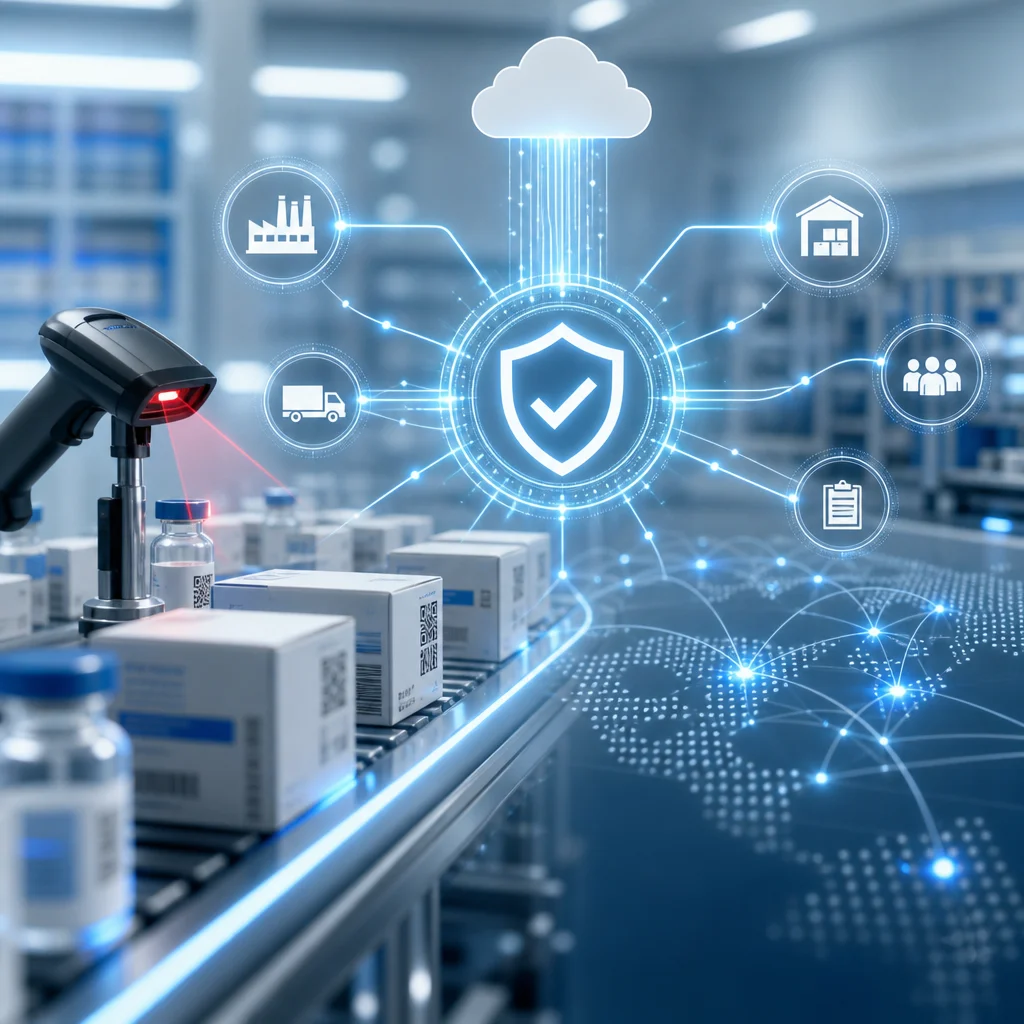
We’ve built our platform specifically around the serialized pharmaceutical supply chain, which means DSCSA compliance is embedded into every transaction, not bolted on afterward. Our approach eliminates the manual handoff problem by capturing, validating, and storing transaction data automatically at the point of activity.
Here’s how it works in practice: When a product receives or ships in your warehouse, our system captures the serialization data, validates it against regulatory requirements, and immediately logs the transaction. No data entry. No delays. No errors. The transaction is simultaneously available for internal visibility and formatted for external reporting.
Our DSCSA reporting automation handles:
- Automatic transaction data capture: Every product movement generates a compliant transaction record with all required fields populated from source systems.
- Real-time validation: Data is validated against DSCSA rules and FDA expectations immediately, flagging any missing or malformed information before it causes downstream issues.
- Audit-ready documentation: All transaction history, partner communications, and compliance records live in a centralized repository accessible during audits or regulatory inquiries.
- Recall response automation: When a recall is declared, our system instantly identifies affected inventory across all locations and partners, enabling rapid response.
- Reporting generation and submission: Compliance reports are generated automatically and can be submitted to partners or regulators with a single action.
The shift from manual to automated compliance means your team moves from execution to oversight. Instead of creating reports, they’re monitoring compliance metrics, analyzing supply chain patterns, and responding to exceptions. That’s a meaningful change in how effectively your organization operates.
Real-Time Visibility Across Your Entire Supply Chain
Compliance and visibility aren’t separate initiatives. They’re interdependent. Our track and trace software provides real-time visibility into product location, status, and transaction history throughout your supply chain network.
This visibility enables several operational advantages:
- Immediate recall response: When a recall is issued, you know instantly which warehouses, retailers, or customers have affected inventory. No more guessing or waiting for partner feedback.
- Counterfeit detection: Anomalies in product movement, unexpected transaction patterns, or serialization inconsistencies surface automatically, helping you identify suspect products before they reach patients.
- Inventory optimization: Understanding where products sit at each supply chain node helps you identify slow-moving inventory, optimize reorder points, and reduce carrying costs.
- Partner performance monitoring: Real-time data shows you which distributors or retailers are properly capturing and reporting transaction data, and which are creating gaps.
A pharmaceutical manufacturer we work with reduced their recall response time from 48 hours to 4 hours by implementing our visibility layer. Their operations team can now run a query and instantly see every unit of a recalled product across their entire distribution network. This kind of rapid response protects patients and preserves your brand reputation when time matters most.
Automated Data Capture and Regulatory Submission
The technical backbone of automated compliance is reliable data capture. Our platform integrates with warehouse management systems, inventory systems, and eCommerce platforms to capture serialization data at the moment of truth, whether that’s manufacturing, receiving, warehousing, or shipment.
We handle the complexity of multiple data sources and formats. Your WMS might capture data one way, your ERP another, and your eCommerce platform a third. Our integration layer normalizes these inputs, validates them, and stores them in a compliant format. When it’s time to report, the data is already prepared.
Regulatory submission becomes straightforward. Instead of manually formatting transaction records, generating CSV files, and uploading them through multiple partner portals, our system generates compliant reports automatically. We handle format requirements, field mapping, and submission logistics. Your team approves and submits in minutes rather than hours. This efficiency means regulatory deadlines become routine operational tasks rather than last-minute scrambles.
Financial Impact and Operational Efficiency Gains
Automating DSCSA compliance delivers tangible financial benefits. Most organizations see three primary improvements:
Reduced compliance labor costs: Eliminating manual reporting frees 2-4 FTEs depending on your operation size, representing $150,000 to $300,000 in annual savings. Those resources shift to higher-value activities like supply chain optimization or business development.
Fewer compliance failures: Preventing missed submissions, data quality issues, and audit findings avoids FDA penalties and customer chargebacks. Each incident prevented saves $10,000 to $100,000+ depending on severity.
Improved cash flow: Real-time inventory visibility helps optimize working capital. Reduced carrying costs and faster inventory turns typically yield 5-15% working capital improvements for mid-market distributors.
One pharmaceutical wholesaler we partner with realized $275,000 in annual savings: $180,000 from reduced compliance staff hours, $55,000 from prevented chargebacks, and $40,000 from improved inventory turn rates. Their payback period was under 18 months. When you calculate your own financial impact, start by tracking how many hours your team currently spends on compliance reporting. That number forms the foundation of your business case.
Scaling Your Pharma Business Without Compliance Risk
As your pharmaceutical business grows, compliance shouldn’t become your limiting factor. Many operators hesitate to expand because they know their manual compliance processes won’t scale. Adding new product lines, entering new markets, or acquiring smaller competitors suddenly means exponentially more compliance work.
Our platform scales with your business. Whether you’re processing 100,000 or 10,000,000 units monthly, the compliance infrastructure remains consistent. You add volume without adding headcount. New product lines are onboarded without new manual workflows. Acquisitions integrate quickly because compliance processes are standardized and automated.
This scalability is built into the architecture. Our cloud-hosted ERP handles distributed operations seamlessly, meaning you can expand geographically or operationally without fragmentation. A single compliance framework serves your entire organization, no matter how complex the supply chain network becomes. This removes a significant operational constraint that typically prevents mid-market pharma companies from pursuing growth initiatives confidently.
Integration with Your Existing Systems and Workflows
We recognize that you’ve invested in existing systems and trained teams on current processes. Our platform isn’t a rip-and-replace solution. We integrate with your warehouse management system, inventory management platform, financial systems, and partner networks.
Integration points typically include:
- WMS and inventory systems: We sync product data, lot tracking, and transaction records bidirectionally, so your existing workflows continue operating normally.
- Financial and accounting systems: DSCSA transaction data flows to your GL automatically, ensuring financial records remain in sync with supply chain activity.
- EDI and partner networks: We handle EDI communication with wholesalers, retailers, and manufacturers, translating their data formats into your standardized compliance format.
- Recall management systems: Existing recall workflows integrate with our visibility layer so recall managers have complete, real-time product location data.
Your team’s workflows don’t change dramatically. They work within familiar systems while accessing enhanced visibility and compliance capabilities through our platform. This approach minimizes training burden and adoption friction, allowing your staff to become productive quickly without relearning their daily processes.

Why Pharmaceutical Operators Choose Our Platform
Pharmaceutical operators choose us because we’ve built a purpose-designed solution for their industry. We’re not a generic ERP vendor trying to solve pharma compliance as an afterthought. Our entire architecture, data model, and feature set are designed around the serialized pharmaceutical supply chain.
We bring together DSCSA compliance automation, real-time visibility, financial automation, and business intelligence into a unified platform. That integration matters because compliance data flows into your analytics, which inform your sourcing decisions, which feed back into your compliance requirements. A siloed compliance tool can’t provide that closed-loop optimization.
We also understand the regulatory environment deeply. Our platform evolves as FDA expectations and DSCSA requirements evolve. You’re not trying to adapt a generic platform to changing compliance rules; we’re continuously refining a purpose-built solution to keep your organization ahead of the regulatory curve.
Most importantly, we partner with you on compliance success. We provide training, configuration support, and ongoing optimization to ensure you’re maximizing both compliance effectiveness and operational efficiency. Your success is our success, which is why we’re committed to your long-term outcomes rather than just implementation.
Scaling Compliance as Your Business Grows
Start by assessing your current compliance infrastructure. How many hours does your team spend monthly on DSCSA reporting? How many days would it take you to respond to a regulatory request for full traceability data? How often do you discover data quality issues that require rework? Those answers will inform your business case for automation.
If your pharmaceutical organization is still managing DSCSA compliance through manual processes or fragmented systems, now is the time to evaluate a purpose-built solution. The operational and financial case is clear: automation reduces risk, improves efficiency, and enables growth without compliance constraints.
We’re here to help you navigate this transition. Our team can walk through your specific supply chain, explain how our platform addresses your compliance challenges, and show you the operational improvements you can expect. Reach out to learn more about how we’re helping pharmaceutical operators scale without compliance risk.
Frequently Asked Questions (FAQ)
How does our DSCSA reporting platform reduce manual compliance work?
We automate the data capture and regulatory submission processes that traditionally consume significant resources in pharmaceutical operations. Our serialized ERP system captures product movement across your supply chain and automatically generates the required DSCSA reports, eliminating the manual data entry and cross-checking that creates bottlenecks. This means your team spends less time on compliance documentation and more time on strategic operations.
Can we integrate your platform with our existing systems?
Yes, we’ve designed our platform to work alongside your current infrastructure rather than requiring a complete overhaul. Our cloud-hosted solution connects with your existing workflows and databases, allowing you to implement serialization and compliance automation without disrupting operations. We handle the technical integration work so your team can focus on business continuity.
What visibility do we gain into our drug supply chain with your system?
We provide real-time tracking of product movement from manufacture through distribution, giving you complete visibility into where every serialized unit is located at any moment. Our platform aggregates data across your entire network, enabling you to identify bottlenecks, optimize inventory levels, and respond quickly to supply chain issues. Combined with our business intelligence analytics, you can make data-driven decisions that strengthen both compliance posture and operational efficiency.