
For Teams Already Running an ERP or a Serialization Tool
Switch to a Serialized ERP Built for Pharma
Most ERPs treat serialization as an add-on. RxERP builds it into the core, so one system replaces four to six disconnected tools without a rip-and-replace.
Serialization in the ERP Core
No Rip-and-Replace
Gain Efficiency With One System
Guided Migration
See the Comparison
|
How Migration Works
|
Integrations
Running on RxERP Today







The Cost of Running Multiple Systems
Every Handoff Between Systems Is a Place Where Something Breaks
Your ERP works. Orders go out, inventory moves, business continues. But behind every transaction your team may still be reconciling serial numbers between systems, resolving DSCSA exceptions, checking serialized inventory, and verifying information your ERP was never built to understand.
Reconciling Systems That Should Already Agree
When your ERP and serialization platform operate separately, discrepancies are inevitable. Your team is left comparing records, correcting errors, and determining which system is accurate, all because the data does not live in the same place, under one roof.
Exceptions and Fire Drills
A shipment holds because a record did not sync. An EPCIS file fails validation the day it is due. Serialization software integration is supposed to prevent this, and instead it becomes another thing your team maintains.
Ghost Inventory
You sell units your ERP says you have and the warehouse does not. Every manual count is an admission that the number on the screen was never trustworthy.
The Audit Scramble
Pulling an audit trail means exporting from one system, matching it against another, and hoping it all lines up. An EPCIS integration with an ERP that was never built for it turns what should be simple evidence into a project of manual reconciliation.
Most ERPs Treat Serialization as an Add-On
Generic ERPs were built for industries where a unit is a unit. Pharma is not that. When serialization gets bolted on afterward, traceability lives in a second system and every process that touches a serialized unit has to cross a seam. RxERP’s built-in serialization removes the seam entirely: inventory, pricing, orders, analytics, accounting, licensing and traceability all read from the same data, so there is nothing to sync and nothing to reconcile when two systems disagree. An ERP with built-in serialization is not a longer feature list. It is a different data model.

Compare Pharmaceutical ERP Software Side by Side
If you are evaluating pharmaceutical ERP alternatives, the question is not which system has more features. It is which one keeps serialized inventory, orders, and compliance evidence in the same place.
| Feature |
|
|
|
|
|---|---|---|---|---|
|
Pharma-only industry focus |
|
|
|
|
|
Automated DSCSA & serialization compliance in the ERP core |
|
|
|
|
|
Built-in license management system |
|
|
|
|
|
End-to-end regulatory reporting & audit tools |
|
|
|
|
|
Mobile warehouse app for pharma ops |
|
|
|
|
|
Complete pharma supply chain integration |
|
|
|
|
|
Pharma-specific BI & analytics |
|
|
|
|
|
Serialization in the core versus a separate module or platform |
|
|
|
|
|
EPCIS event generation at transaction level |
|
|
|
|
|
Single source of truth for inventory and traceability |
|
|
|
|
|
Middleware or sync layer required |
|
|
|
|
|
One platform versus a growing module list |
|
|
|
|
|
Built for pharma distribution versus adapted for it |
|
|
|
|
= native capability
= limited or add-on
= not available
Comparison current as of August 2026
Order-to-Cash in One ERP.
Order entry, pricing, fulfillment, and invoicing in a single system.
Real-Time Pharma Analytics.
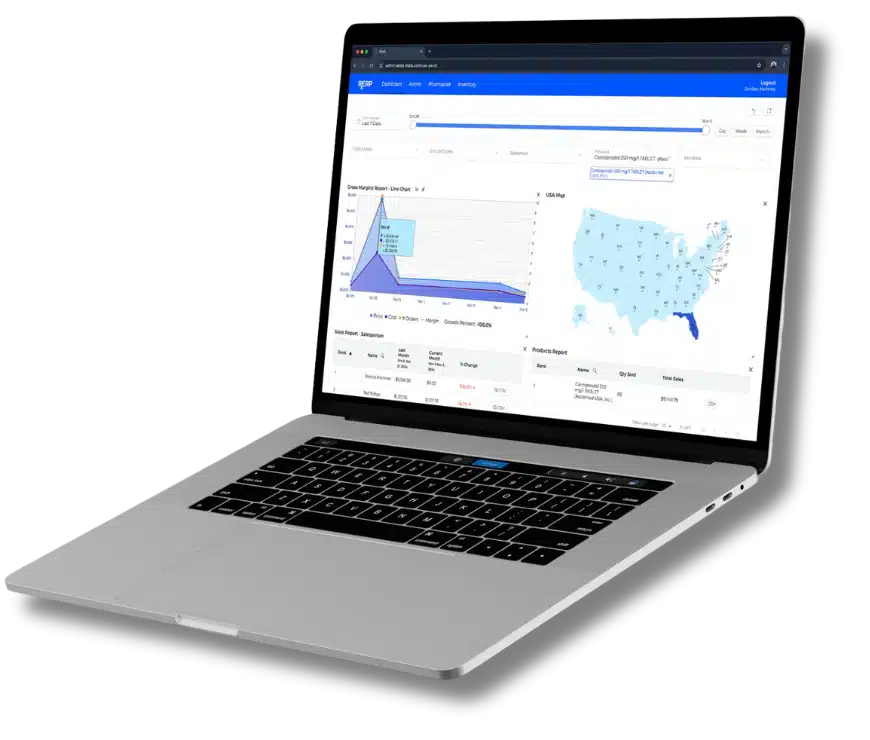
Inventory value, margin, and compliance status in one dashboard.
Mobile Warehouse App.
Receiving, stocking, and fulfillment from any device, synced live to the ERP.
Lot and Expiry Tracking.
Every serialized unit tracked from receipt through distribution.
Documents Generated With the Order.
Invoice, packing list, T4 report, EPCIS file, SSCC label, and shipping label, all produced automatically as the order moves.
No Middleware to Maintain
Switching does not mean replacing your entire technology stack. RxERP integrates with the accounting, warehouse, and order management systems you already run, so you keep your accounting system and replace the layer that was never doing real work: the middleware holding your ERP and your serialization tool together. When you replace serialization software with serialization inside the ERP, every receipt, transfer, and sale generates its own EPCIS and transaction records at the moment it happens. There is no sync job to monitor and no nightly file to chase.
Connect what you have. Replace what you would rather stop maintaining.
What RxERP connects to:
- accounting and general ledger
- warehouse and shipping systems
- EDI trading partners
- ecommerce and order channels.
What RxERP can replace:
- your EDI provider
- your warehouse management system
- your ecommerce and order management layer
- standalone serialization platforms
- EPCIS middleware
- spreadsheet reconciliation layers
- separate compliance reporting tools

Switch ERP Systems Without the Chaos
1
Connect What You Already Run
We map your current stack first: what stays, what gets replaced, and what has to talk to what. Integrations to accounting and warehouse systems are configured before any data moves.
2
Running on RxERP Today.
Historical transaction and serialization data is migrated and validated while your current system keeps running. You compare the two side by side before anything depends on the new one.
3
Cut Over on a Date You Pick
Cutover happens on your schedule, not ours, with support on the floor through your transition and beyond — the same people stay with your team through the first month-end close, the first audit pull, and the first full inventory cycle, not just go-live week. Replacing a legacy ERP does not mean a hard stop on a Friday and a prayer on Monday.
4
Operate on One System
Your team runs inventory, orders, pricing, and compliance evidence in one place. The reconciliation work that used to fill a morning stops existing.
In most cases RxERP goes live in half the time a conventional ERP implementation takes, or less, because there is one unified system to stand up instead of several.

The Four Reasons Teams Put This Off
1
Cost of change.
The real cost is not the license, it is the hours your team already spends reconciling multiple systems. One system covering serialization, compliance, inventory, orders and finance replaces a stack you are paying for in pieces, and implementation support is included rather than quoted separately.
2
Downtime risk.
Nothing gets switched off until the new system has run in parallel against the old one and matched it. Cutover happens on a date you choose, with support on the floor.
3
Internal buy-in.
Internal buy-in. The warehouse team is the hardest group to convince and the fastest to convert, because the mobile app replaces a clipboard. Compliance heads come around just as quickly, because serialization sits inside the system they already have to answer for rather than beside it. Bring one supervisor and one compliance lead to the demo and let them run it.
4
Mid-contract timing.
Mid-contract timing. If you are outgrowing your ERP but locked in until renewal, compare now and time the move to your renewal date rather than discovering your options weeks before it. Most teams start the evaluation a quarter out. Stuck in a contract? Talk to your RxERP rep about it, because contract buy-outs are on the table.
One Platform for the Whole Operation
RxERP covers what most teams buy in pieces: automated serialization compliance, ecommerce, sales and marketing, CRM, business intelligence analytics, finance and accounting, inventory and warehouse management, and license management. One system, one set of data, one operation to run. Implementation support is included rather than quoted separately.

Your business is unique — so is your pricing.
Let’s build a cost model that fits your operation.
Lifsa: chose RxERP over an alternative serialized system.
We chose RxERP due to its unique position as the sole serialized ERP specifically designed for the pharmaceutical supply chain sector. In our collaboration with the company, ensuring our success remains RxERP's foremost priority.
Raj Kumar,
CEO at Lifsa
I am excited about the extensive, innovative functionality tailored for the pharmaceutical supply chain that RxERP is providing. The solution is helping us in enhancing pharmaceutical supply chain operations and improving our business processes.
Omar Awadalla, President,
and Owner of SublimeRx
We chose RxERP due to its unique position as the sole serialized ERP specifically designed for the pharmaceutical supply chain sector. In our collaboration with the company, ensuring our success remains RxERP's foremost priority.
Common Questions
Serialized ERP FAQ
What are the best pharmaceutical ERP alternatives if we already run an ERP?
It depends on whether serialization is a requirement or an afterthought for you. Teams looking at pharma ERP alternatives usually land on one of three options: keep a generic ERP and add a serialization tool, move to a distribution ERP with a pharma module, or move to a system where serialization is in the core. RxERP is the third. The comparison above shows where each option differs on traceability, reconciliation.
How long does migration actually take?
Less time than a conventional ERP implementation, in most cases about half or less, because serialization, inventory, orders, and compliance are one system to stand up rather than several to integrate. The real number depends on how many integrations you need and how much historical data comes across, so you get a timeline mapped to your own stack before you commit to anything.
Do we have to replace our accounting system?
No. RxERP integrates with the accounting, warehouse, and order management systems you already run. Most teams start by consolidating the workflows creating the most manual work, then expand from there.
What happens to our historical transaction and serialization data?
It comes with you. Historical records are migrated and validated during the parallel run, so audit trails stay continuous across the cutover rather than splitting across two systems.
Can we run RxERP in parallel with our current system?
Yes, and we recommend it. Running both side by side is how you confirm the numbers match before anything depends on the new system.
What if we are mid-contract with our current serialization vendor?
Compare now and time the move to your renewal date. Starting the evaluation a quarter before renewal gives you real leverage and avoids an auto-renew you did not intend. And if you are stuck in a contract, talk to your RxERP rep about it, because contract buy-outs are on the table.
What if our team resists the change?
Bring the people who will use it to the demo, especially warehouse supervisors and whoever owns compliance. The floor team is usually the fastest group to convert because the mobile app replaces manual counts and paperwork, and compliance leads tend to come around once they see serialization running inside the system rather than beside it.
What is the best ERP for distributors in the pharmaceutical industry?
The best ERP for the pharmaceutical industry is the one that treats a serialized unit as a first-class record rather than an attribute bolted onto a product. For organizations on the pharmaceutical supply chain, from pharmaceutical wholesalers and 3PLs to micro-distributors and manufacturers, that means serialization, inventory, pricing, and order-to-cash reading from the same data. Compare pharmaceutical ERP software on that single test and the field narrows quickly.
See What One Serialized System Looks Like Next to Yours
Get a side-by-side against your current stack and a migration plan built around how you actually operate. No rip-and-replace, no generic product tour.