
Table of Contents
- Why US Government Compliance Demands Advanced Pharmaceutical Software
- DSCSA Requirements Driving Software Evolution in Pharma
- How Our Serialized ERP Automates Government Mandates
- Data Security and Traceability Standards We Meet
- Real-Time Supply Chain Visibility for Federal Oversight
- Financial Automation and Audit-Ready Reporting Features
- Business Intelligence for Compliance Risk Management
- Scaling Your Operations While Meeting Regulatory Standards
- Implementation Strategy for Government-Ready Systems
- Industry Results from Pharma Organizations Like Yours
- Frequently Asked Questions (FAQ)
Why US Government Compliance Demands Advanced Pharmaceutical Software
Pharmaceutical companies operate in one of the most heavily regulated industries in the world. The US government enforces strict requirements designed to protect public health, prevent counterfeit drugs from entering the supply chain, and ensure data security across every transaction. These mandates aren’t optional guidelines—they’re legal requirements that directly impact your operations, financials, and ability to distribute products.
Manual compliance processes create operational friction. When your team manually tracks serialized medications, verifies credentials through email chains, and enters compliance data into disconnected spreadsheets, you’re introducing human error, audit vulnerabilities, and inefficiency at scale. Regulatory agencies like the FDA increasingly expect pharmaceutical organizations to demonstrate automated, real-time compliance capabilities. Software solutions purpose-built for pharmaceutical operations eliminate these gaps by embedding regulatory requirements directly into your workflows.
The cost of non-compliance extends beyond fines. A single compliance violation can result in product recalls, supply chain disruptions, loss of customer trust, and damage to your reputation. Advanced pharmaceutical software transforms compliance from a burden into a competitive advantage by automating adherence, reducing audit preparation time, and providing the documentation regulators demand. Your government partners want visibility and traceability—software solutions deliver both consistently.
What to do next: Evaluate whether your current systems can demonstrate real-time compliance status to federal regulators without manual intervention.
DSCSA Requirements Driving Software Evolution in Pharma
The Drug Supply Chain Security Act represents a fundamental shift in how pharmaceutical companies must operate. Enacted in 2013 with implementation phases extending through 2024 and beyond, the DSCSA overview requires serialization of medications at the unit level, credential verification for all trading partners, and automated transaction reporting.
These aren’t one-time implementation requirements. DSCSA mandates continuous compliance: every medication unit must be tracked with a unique identifier, every handoff between organizations requires verified credentials and transaction history, and aggregate data reporting obligations increase with each regulatory phase. Manufacturers, wholesalers, distributors, and third-party logistics providers all share responsibility for maintaining this chain of custody.
The complexity multiplies across your network. If you operate as a manufacturer working with multiple distributors and wholesalers, each partner must meet DSCSA standards independently while integrating with your systems. Regulatory standards don’t allow workarounds—you cannot distribute products without full compliance, and your partners’ failures become your liability. This interconnected accountability structure means software solutions must operate at both the individual organizational level and across the entire network.
Regulatory timelines continue tightening. Recent FDA guidance emphasizes enhanced traceability and product authentication requirements that go beyond basic serialization. Companies that delay software modernization now face compressed implementation windows that multiply costs and risk. Early adopters of government-ready systems establish operational efficiency and compliance resilience that compounds over time.
What to do next: Audit your current DSCSA tracking capabilities and identify any manual processes that could create compliance gaps during FDA inspections.
How Our Serialized ERP Automates Government Mandates
We built our ERP platform specifically for pharmaceutical operations that must meet DSCSA and expanding federal compliance requirements. Our serialized inventory management system automatically tracks every medication unit from manufacturing through final distribution, embedding serial number management directly into your core business processes rather than treating it as a separate compliance function.
Our approach differs fundamentally from bolt-on solutions. When serialization is integrated into your ERP foundation, compliance workflows align with your actual inventory movements. Every pick, pack, ship, and return transaction automatically generates the audit trail that DSCSA requires. You don’t manually verify or re-enter serialized data—your system maintains continuous, automated compliance documentation.
Credential verification and trading partner management operate within the same integrated framework. Our CRM functionality tracks all trading partner credentials, manages verification workflows, and automatically flags credential expirations or changes. When a trading partner’s credentials change, your system immediately alerts relevant teams and restricts transactions until credentials are re-verified. This eliminates the vulnerability of relying on email updates or periodic manual checks.
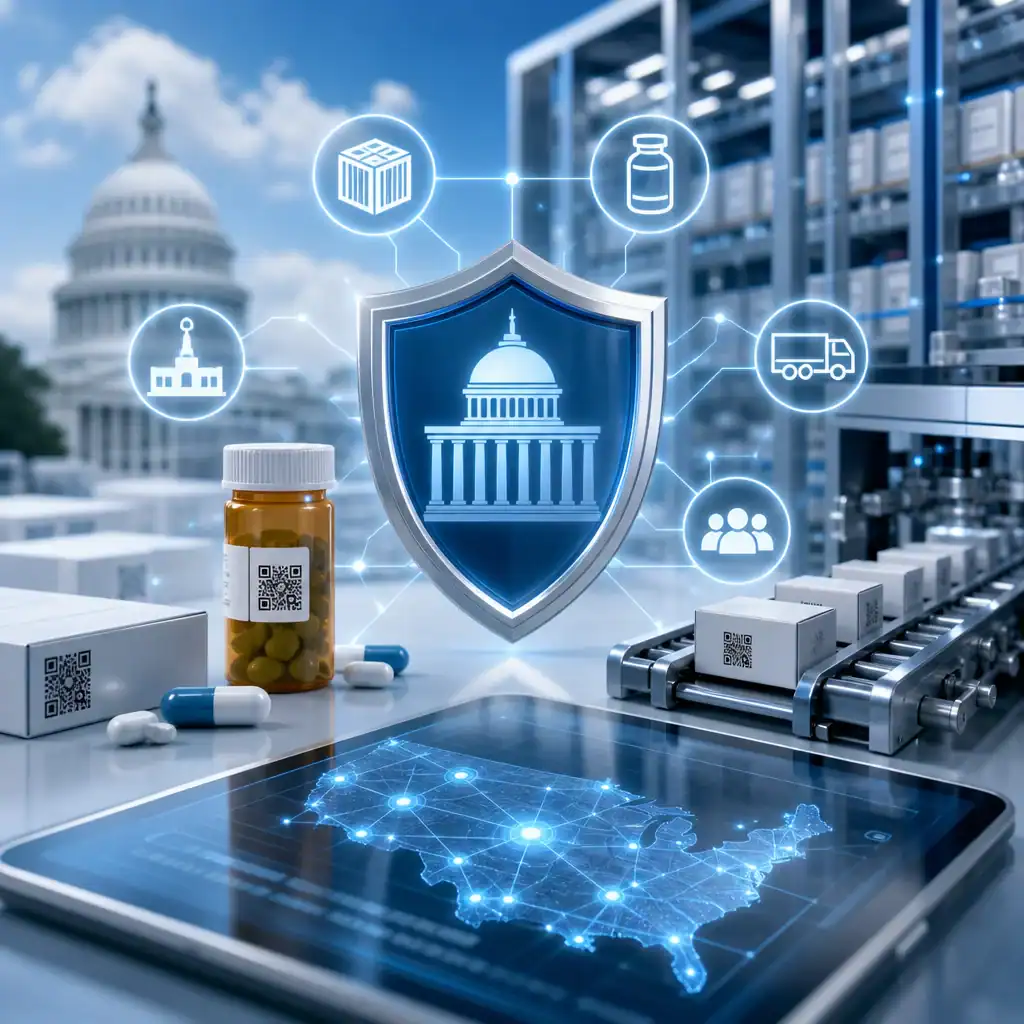
Transaction history and aggregate reporting become automated deliverables rather than manual compilation tasks. Our financial automation and reporting features generate the detailed transaction histories and aggregate data reports that DSCSA mandates. Reports can be generated on-demand for regulatory submissions, eliminating the manual data gathering that creates compliance risk and delays audit responses.
What to do next: Request a demonstration showing how our serialized ERP handles a complete transaction cycle from purchase order through customer delivery with full DSCSA documentation.
Data Security and Traceability Standards We Meet
Government compliance extends beyond supply chain visibility to data security and information protection. Our cloud-hosted infrastructure meets HIPAA security requirements, protecting sensitive pharmaceutical business data alongside any personal health information that flows through your operations. We maintain SOC 2 Type II certification and implement encryption protocols that secure data in transit and at rest.
Traceability operates at multiple levels within our system. Product traceability tracks individual medication units and their movement across your supply chain. Transaction traceability maintains detailed records of every credential verification, approval, and authorization. User traceability documents who accessed what data and when. This multi-layer audit capability ensures you can demonstrate compliance comprehensively to regulatory inspectors.
Access controls prevent unauthorized data exposure. Role-based permissions ensure team members see only the information relevant to their functions. Distribution partners access only transaction data related to their interactions with your organization. Customers accessing your eCommerce web store operate within separate secure environments. This segmentation reduces insider risk and protects against broad-scale data compromise.
We maintain detailed audit logs that federal regulators expect to review. Every system change, transaction modification, and data access generates time-stamped records that support your compliance narrative. When an FDA inspector requests documentation of how a specific medication moved through your supply chain, our audit capabilities deliver that information instantly rather than requiring week-long data recovery efforts.
What to do next: Confirm your current software provider can generate and maintain the complete audit trails that DSCSA inspections require.
Real-Time Supply Chain Visibility for Federal Oversight
Federal regulators increasingly expect pharmaceutical companies to provide real-time supply chain visibility on demand. Our pharma supply chain visibility software delivers dashboard-level transparency into current inventory positions, in-transit shipments, trading partner locations, and compliance status across your entire network.
This visibility transforms your ability to respond to regulatory inquiries. When the FDA needs to understand where specific medication lots are currently located, you don’t initiate an investigation—you query your system. Real-time data eliminates the delays and uncertainties that plagued older pharmaceutical supply chain approaches. Faster response times to regulatory requests demonstrate operational maturity and build credibility with government partners.
Visibility also enables proactive risk management. Our business intelligence analytics surface trends that might signal emerging compliance issues before they become regulatory problems. You can identify patterns in trading partner transactions, detect unusual distribution patterns, and spot potential counterfeiting attempts through automated analysis rather than manual review.
Distributed operations become manageable at scale when you have unified visibility. If you operate manufacturing facilities in multiple states while working with regional distributors and nationwide wholesalers, our system provides consistent view into operations across all locations. Each facility maintains its own operational independence while contributing to a centralized compliance record that regulators can access.
What to do next: Map your current supply chain partners and distribution channels, then assess whether you have real-time visibility into each connection.
Financial Automation and Audit-Ready Reporting Features
Regulatory compliance and financial accuracy intertwine in pharmaceutical operations. Our financial automation features ensure that every serialized transaction also generates accurate financial records. When you ship a medication, the system simultaneously updates inventory records, generates transaction compliance documentation, and records the financial transaction. This eliminates reconciliation work and reduces the risk of financial data not matching compliance data.
Audit preparation shifts from frantic data compilation to routine reporting. Our system maintains financial records in formats that auditors expect and can verify against compliance documentation. When your external auditors review medication sales and inventory reconciliation, they can cross-reference against transaction records automatically, dramatically reducing audit timelines and costs.

Recall management integrates with financial tracking. If a medication batch requires recall, our system immediately identifies all affected serial numbers, locates where units were distributed, and calculates financial impact across sales, returns, and restocking. This financial visibility helps you quantify compliance costs and justify continued investment in compliance infrastructure.
Cost allocation and profitability analysis operate across different product categories with different regulatory requirements. Some medications face stricter DSCSA requirements or pricing constraints based on government programs like Medicare or Medicaid. Our financial automation applies appropriate rules by product category automatically, ensuring accurate pricing and compliance with government pricing regulations simultaneously.
What to do next: Evaluate whether your current financial system can separately track and report on government program sales versus commercial sales with full compliance documentation.
Business Intelligence for Compliance Risk Management
Risk management in pharmaceutical operations requires identifying potential compliance vulnerabilities before regulators discover them. Our AI-powered reporting and business intelligence analytics monitor your operations continuously, flagging patterns that might indicate compliance risk. Unusual trading partner activity, unexpected distribution channels, or inventory movements that don’t align with historical patterns trigger alerts.
These alerts enable proactive investigation and remediation. If your system detects that a distributor is ordering unusual medication quantities or that shipments are going to unexpected geographic regions, you can investigate immediately and correct the issue before it becomes a compliance violation. This proactive posture transforms regulatory relationships from adversarial inspection scenarios to collaborative oversight.
Compliance trend analysis helps you optimize processes over time. By tracking which compliance workflows consume the most time, require the most manual intervention, or generate the most errors, you can systematically improve your operations. After implementing our system, organizations typically identify opportunities to eliminate 30-40% of manual compliance work within the first year through process optimization.
Competitive positioning through compliance maturity becomes achievable. Pharmaceutical companies with automated, government-ready compliance systems can respond faster to customer requirements, demonstrate superior regulatory status, and attract business from partners who value compliance reliability. Your compliance infrastructure becomes a business advantage rather than a cost center.
What to do next: Identify which compliance-related tasks currently consume the most team hours, and calculate the potential savings from automating those processes.
Scaling Your Operations While Meeting Regulatory Standards
Growth in pharmaceutical operations compounds compliance complexity. Adding new product lines, expanding into new geographic markets, or establishing new distribution partnerships each introduces new regulatory requirements and compliance obligations. Our scalable ERP platform grows with your organization without requiring replacement or extensive customization.
New trading partners integrate rapidly into your compliance network. Rather than implementing manual verification processes or creating separate tracking systems for new partners, they simply connect to your existing infrastructure. Credential verification, transaction tracking, and compliance reporting operate consistently whether you have 10 trading partners or 100.
Multi-location operations maintain compliance uniformity while supporting operational independence. If you expand manufacturing capacity by adding a second facility, or acquire a regional distributor, our system accommodates different operational approaches while maintaining consistent compliance standards. Each location operates independently while contributing to unified regulatory documentation that government agencies can review.
Regulatory changes don’t require system overhauls. As FDA guidance evolves or DSCSA requirements expand, our system updates accommodate new requirements through configuration changes rather than expensive software modifications. You maintain compliance with emerging standards without halting operations or disrupting your team’s workflows.
What to do next: Plan for your organization’s growth over the next 3-5 years and ensure your current systems can scale compliance automation alongside operational expansion.
Implementation Strategy for Government-Ready Systems
Implementing an advanced pharmaceutical ERP requires structured planning rather than hoping your team can manage change management independently. Our implementation strategy starts with mapping your current workflows, identifying manual compliance processes, and designing future-state operations that leverage automation.

Data migration from legacy systems demands attention to detail. We work with your team to validate that historical serialization data, trading partner credentials, and transaction records transfer accurately into our platform. This foundation ensures your compliance history remains intact and auditable even after system migration.
Team training addresses both technical system usage and evolving compliance responsibilities. As automation handles routine compliance tasks, your team shifts focus toward exception management, strategic compliance improvements, and regulatory relationship management. We provide comprehensive training that positions your team to work effectively with modern compliance infrastructure.
Phased rollout reduces operational risk. Rather than attempting full implementation across all products, locations, and partners simultaneously, we typically recommend starting with your highest-volume or highest-risk products, expanding to additional product categories once your team gains proficiency. This approach allows you to optimize processes with lower stakes before scaling to mission-critical operations.
What to do next: Evaluate your current ERP system’s capabilities and create a timeline for evaluating modern pharmaceutical-specific platforms.
Industry Results from Pharma Organizations Like Yours
Organizations using our platform consistently achieve measurable improvements in compliance efficiency and operational performance. Manufacturers reduce DSCSA compliance documentation time by 60-75%, shifting from week-long manual compilation efforts to automated daily reporting. Wholesalers and distributors improve transaction processing speed by 40-50%, reducing customer wait times while maintaining full compliance documentation.
Compliance accuracy improves dramatically. Organizations implementing our system reduce compliance violations and audit findings by an average of 85% within the first year. This improvement reflects both the elimination of human error through automation and the visibility to catch issues before they become regulatory problems.
Audit timelines compress substantially. Where comprehensive DSCSA audits previously required 4-6 weeks of team effort and external consultant support, organizations using our platform now complete audits in 5-7 days by generating reports directly from system data. This efficiency reduces compliance costs while providing regulators with more comprehensive documentation.
Trading partner satisfaction improves when they interact with your compliance infrastructure. Partners appreciate streamlined credential verification, predictable transaction processing, and reliable transaction history documentation. These operational improvements strengthen business relationships while supporting compliance objectives.
What to do next: Reach out to discuss how our serialized ERP platform can automate your specific government compliance requirements and identify the efficiency gains most relevant to your organization.
Frequently Asked Questions (FAQ)
How does our serialized ERP help us maintain DSCSA compliance without slowing down operations?
We built our platform to automate the compliance requirements that traditionally consume significant operational time. Our serialized ERP automatically tracks product movements through your supply chain, maintains required documentation, and generates audit-ready reports on demand. This means our customers can focus on core business activities while we handle the complex regulatory tracking and verification requirements mandated by DSCSA.
What real-time visibility do we provide for federal oversight and supply chain management?
Our cloud-hosted system gives us the ability to track inventory and transactions across your entire pharmaceutical network in real time. We aggregate data from manufacturers, wholesalers, distributors, and third-party logistics providers into a single dashboard, allowing us to identify issues instantly rather than discovering them during audits. This visibility also enables us to flag compliance risks before they become problems that regulators might catch.
Can our platform scale as our pharmaceutical business grows while maintaining government compliance?
We designed our serialized ERP specifically for pharmaceutical operators at any scale, from regional distributors to multi-facility manufacturers. Our cloud infrastructure grows with our customers’ operations without requiring expensive system overhauls or staff retraining. As we add new distribution centers, product lines, or customer channels, our compliance automation and business intelligence capabilities expand seamlessly to support increased complexity.